Place
Tayrona National Park
Colombia's Caribbean jungle-and-beach national park east of Santa Marta — two entrances, hikes measured in hours, and beaches you are allowed to sleep on.
Tayrona National Park
A national park on Colombia’s Caribbean coast, roughly 45–50 minutes by road from Santa Marta. Jungle running down to beaches, with marked routes between them and campsites you can sleep at.
Harry arrives at dusk to stay just outside it, and everything on this page from that evening comes from hostel staff and from other travellers either finishing the park or about to start it.
Getting in
- Entry: 70,000 pesos, about £15 or $18 (from video – unverified).
- Two entrances, and the choice changes the day completely. The main entrance is the short way in and much busier. Calabazo is the longer, quieter route — about a three-hour walk — and it is the one Harry takes.
- Officially you need a passport and a yellow-fever certificate. Neither was checked properly: one passport between four people, and no vaccine record asked for. Recorded as what happened rather than as what to expect.
- Two beaches to sleep at. Playa Brava — quiet, no swimming allowed, and the one he picks — and Cabo San Juan, the popular one, where you can swim.
- Hammocks, tents and private cabins at the camps; hammocks are the usual arrangement and about $8.
- Horses can be hired: 80,000 pesos each way (from video – unverified).
- Mosquitoes are a real consideration — nets are provided and staff tell him to use his.
- An indigenous village on the Calabazo trail offers a short tour for 10,000 pesos a head; filming is allowed but not for social media.
Staying at the edge
Harry stays at Eco Hostel Yuluka, immediately outside the park so he can start walking at first light. He booked it the same afternoon on a hostel site having read that it was basic and good only for its location, and it beat his expectations comfortably.
- A private room: around £45–50, roughly $60 (from video – unverified). He notes the deluxe room was only about £3 more.
- Bamboo-built room, mosquito net, working fan, a marble bath and a shower open enough that it feels like washing in the jungle.
- Hammocks outside, and — his favourite thing about it — nothing audible at night but the jungle.
- Wi-fi is poor, which he shrugs off on the grounds of where he is.
He paid for this himself, nothing was given or discounted, and no booking link or code appears — which is why it is named here.
Why the hostel mattered more than the room
The evening downstairs is the practically useful part of the stay. A group of travellers — five English, one Polish, one Dutch, two Swiss — were either coming out of the park or going into it the next day, so between them they had the entrances, the campsites and which sections were worth the walk. Harry says this decided how he would book for the rest of Colombia: hostels for the information and the company, but a private room inside them for the laptop and the camera.
Outside the park: an indigenous community
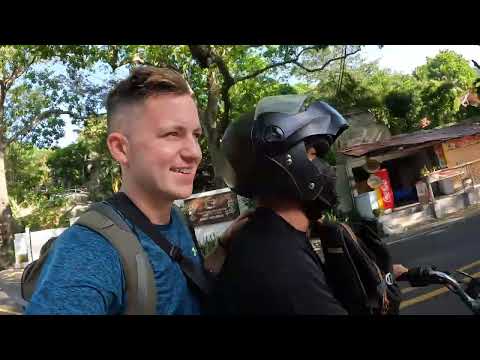
Harry spends a day with an indigenous community in the hills just outside the park — reached by about twenty minutes on the back of a motorbike through the jungle, no helmet, the last stretch off-road, then a five to ten minute walk.
The community does not normally admit outsiders, and he is told his visit is a special exception. He is asked not to enter one area, described to him as holy; filming elsewhere is permitted and he asks before doing it. The tribe is not named on camera and is not named here.
- Around 100 people (from video – unverified).
- How long they have been there is contradicted inside the video. Harry’s own opening narration guesses they have lived in the area for thousands of years; on site, the answer he is given is 21 years (from video – unverified). The figure from the conversation is the one recorded here and the narration is noted as differing, per the usual handling of a video that disagrees with itself.
- Contact with the outside is minimal — a supermarket run roughly once a month. Children attend a school run for the tribe rather than a public one, and classes had been interrupted by the pandemic. Older children work.
- Language: Spanish.
Houses
Mud-walled, built on wood and bamboo with a wooden roof, containing a bed, a fireplace and a hammock. The mud is thick enough that the inside is noticeably cool in serious outside heat, which is the detail Harry keeps coming back to. One man tells him he built his own in two weeks (from video – unverified).
Cacao
Grown, sun-dried on site, and sold on. The pods are opened and the white pulp around the seeds is eaten straight — extremely sweet, and nothing like chocolate to taste. You suck it rather than chew, or it turns bitter.
Coca
The community grows, picks and dries coca leaf. Women pick the leaves and men process and dry them, using a heated stone in a gourd. It is used medicinally and ceremonially, including at weddings.
Harry chews it for the rest of the day and reports the effect accurately: not overpowering, a mild buzz and useful energy on the walk, and a taste he doesn’t enjoy.
Obs: the guide gives a ratio of leaf to cocaine, and the auto-subtitles render it as one ton of leaves per gram. That figure is almost certainly a transcription or translation slip — nothing in the material lets us establish what was actually said, so the ratio is recorded as stated and should not be relied on (from video – unverified). The point being made — that the leaf as grown and chewed here is a different thing from the processed drug — is clear enough regardless.
The ceremony
A cleansing, which Harry describes as being asked to empty his thoughts and then to hold his hopes in mind, ending with cotton bracelets tied on him that he is told stand for earth, water and nature. He says frankly that he followed only part of it. Cotton itself is described as important — the explanation given is that what is in your mind passes into it.
Getting there
Arranged through a local guide, and the arrangement is the point: this is a community that would not otherwise let him in. Harry says on camera that this particular tribe does not take tourists, and that other communities in the area can be visited if you make contact far enough ahead.
The guides are not named here. Their booking details are published in the video description, which is what the naming rule turns on — the service is recorded, the contact is not. He does not state what the day cost, despite saying at the start that he would.
Access can also fall through. A friend of his had booked the same experience earlier in January and had it cancelled the day before, because the community was several days into a celebration.
A waterfall
The day ends at a natural rock slide in the jungle nearby — a chain of clear pools running down a rock face into a river, with loose rock above one section that Harry decides to avoid. There are monkeys in this stretch of forest, but they arrive too late in the day to see any.
The waterfall hike
The following day he goes back into the same jungle for a bigger one, with the same two guides.
- About 45 minutes each way — but the difficulty is scrambling, not distance. Harry calls it one of the hardest hikes he has done, and the reason is that long sections are climbing over rock rather than walking.
- It is not a tourist attraction and isn’t signposted as anything. The guides took him because they knew it as a local spot, and he says he would not have found or attempted it alone. This is the strongest argument in the cluster for hiring someone locally — see travel with a local guide.
- The pool at the end is deep enough to dive into, in shade and properly cold, which after the climb is the point of it.
- Things to look at on the way: giant green and yellow bamboo, used for building; and a tree the guides put at 600–800 years old, said to live to a thousand (from video – unverified).
- The return has a shortcut across private land, and the guides stop to ask the household’s permission before crossing it.
The beach
About 100 metres off the main road, past a row of hostels and restaurants, and Harry calls it the nicest beach he has seen in Colombia — properly Caribbean, palm trees, real waves, mountains behind it, and a good colour of sand. He hadn’t known it was there.
Handicrafts from the mountain community are sold on the sand, mainly woven bracelets, by sellers who come down for the day and are not pushy. A bracelet was 6,000 pesos and Harry paid 20,000 — about a dollar against four or five (from video – unverified) — on the grounds that six thousand is nothing. He notes that a self-sufficient community still needs cash for things like electricity.
Back at the hostel
He extends his stay and changes rooms: a bigger bed, a television, a bath and, in place of an indoor shower, an outdoor shower in the jungle, which he rates highly and finds cold. Hammocks with a view over the forest.
Harry’s tips
- Get in position the night before. Staying at the entrance is what makes a dawn start possible.
- Ask the people coming out. They walked it today; the staff and the listings did not.
- Take a private room in a hostel if you carry gear. The sociability without leaving a laptop in a dorm.
- If you want to meet an indigenous community, arrange it a long way ahead. The one Harry sees doesn’t take visitors at all; others will, with notice, and a booking can still be cancelled the day before.
- Ask before you film, and expect areas you can’t enter. He does both, and neither costs him anything.
Source videos
- A Day In My Life Living In COLOMBIA 🇨🇴 — https://www.youtube.com/watch?v=EuJASkbvem4
- Tourists Not Allowed In This Colombian Jungle 🇨🇴 — https://www.youtube.com/watch?v=DsjAdBn5PCw
- Colombia Waterfall Hunt 🇨🇴 — https://www.youtube.com/watch?v=4LdGNY4zQtk
- Sleeping on the Beach In Colombia 🇨🇴 — https://www.youtube.com/watch?v=vy2ZMxjBMKc
- Hiking to a Nudist Beach in Colombia 🇨🇴 — https://www.youtube.com/watch?v=W3IZFKlxjFs
Videos featuring Tayrona National Park

Video
Colombia Waterfall Hunt 🇨🇴
A hard scramble to an unmarked waterfall outside Tayrona, a shortcut across someone's land, and the nicest beach Harry finds in Colombia — reached without knowing it was there.
Video
Tourists Not Allowed In This Colombian Jungle 🇨🇴
A day with an indigenous community outside Tayrona that doesn't admit outsiders — cacao, coca leaf, a cleansing ceremony, and a guide who couldn't explain any of it in advance.

Video
A Day In My Life Living In COLOMBIA 🇨🇴
A working day in Santa Marta — a $5 co-working pass, four videos scheduled before going off-grid, a £5 shave, and a jungle hostel at the edge of Tayrona.

Video
Sleeping on the Beach In Colombia 🇨🇴
A three-hour walk into Tayrona to the beach nobody goes to, an $8 hammock on the sand, no phone signal, and the best night Harry has in Colombia.

Video
Hiking to a Nudist Beach in Colombia 🇨🇴
Walking out of Tayrona to Cabo San Juan — bananas off the tree, a beach with four toilets and a thousand visitors a day, a dog that follows them out, and a night arrival in Minca.
Linked from
- Cabo San Juan Place
- Minca Place
- Playa Brava Place
- Santa Marta Place
- Colombia Country
- Ask travellers coming the other way Tip
- Book for the wi-fi when you work on the road Tip
- Travel with a local guide Tip