Country
Bangladesh
Harry's observations from his 2023 Bangladesh series — the world's densest city, a garment industry that clothes the West, and hospitality he ranks against Pakistan's.
Bangladesh
Harry spent an extended trip in Bangladesh in early 2023, based in Dhaka. He had been to the country once before without entering the city. The recurring themes are density, cheerfulness under it, and an economy whose most visible product is the clothing on Western shelves.
Observations
From First Impressions of DHAKA, Bangladesh (Busiest City on Earth) 🇧🇩
- Scale: 22 million in Dhaka, which he calls the most densely populated city in the world, and 160 million in the country.
- People: the strongest first impression he says he has had anywhere. A full day in crowded markets without meeting anyone in a bad mood, and he compares the hospitality directly with Pakistan’s.
- Language: Bengali, and Harry’s Hindi and Urdu reflexes keep betraying him. He notes the similarities between Hindi and Bengali and apologises on camera for using the wrong one.
- Religion: majority Muslim, visible in dress, with other religions present.
- The garment industry is the economic fact he wants viewers to take away: Nike, Adidas, Zara and H&M all manufacture here, and genuine factory stock is sold openly in the markets as “first copy” — a real Zara jacket at 800 taka, about eight dollars. The counterfeits, by contrast, come from China.
- Money and costs (2023): chicken biryani 150 taka, about $1.50; sugarcane juice around 20 US cents; a market shirt 300 taka.
- Eating: by hand, with no cutlery offered.
- Transport: cycle rickshaws with no motor at all, pedalled all day, and faster through Dhaka traffic than the cars.
- Sport: football allegiance runs to Argentina and Brazil rather than England, and cricket is the national conversation.
- Markets are mixed-use: fish stalls, carpenters and steel workers share ground with a live railway line that anyone can walk down.
From $200 Street Shave in Bangladesh 🇧🇩
- Tips are not welcome here, which Harry states plainly and treats as a correction to his own habits. A barber initially refused 20,000 taka and a coconut seller wouldn’t take extra. His note is that this varies country to country and he keeps having to relearn it — see insist on paying.
- Give with the right hand. He thinks he handed money over with his left and flags it on camera as a probable mistake.
- Street barbers charge about thirty cents — 30 taka against 350 quoted by a shop a street away — and work to a fixed order: scissors, antiseptic cream, shaving cream, fresh blade, neck.
- Student districts are where the street food is. Stalls have no fixed pitch and appear nowhere online; the university is where they cluster.
- Wholesale and manufacturing sit behind the shopfronts. Chawk Bazar is where small shopkeepers buy stock, and the mini-factories making soap, eggs and confectionery are through the back. Some employ children; some stand idle when the money isn’t coming in.
- Strangers hand you on. A shopkeeper adopted Harry and passed him down a chain of men each introduced as a brother, which is how he saw any of the above.
- Marriage norms: women marry around 18 and men around 25, and Harry being unmarried at 25 was treated as worth explaining.
- Money and costs (2023): a street shave 30 taka; a ten-minute cycle rickshaw 60; a bike taxi across town 170 after haggling from 200.
From The Most Expensive Hotel In Dhaka, Bangladesh ($200) 🇧🇩
- The top of the market is about $200 a night, which buys a pool, spa, gym and a location in Old Dhaka rather than a modern district.
- Alcohol is available in hotels — there was beer in the minibar, which Harry hadn’t expected in a Muslim-majority country.
- Pork is substituted: beef bacon and beef sausage on the breakfast buffet.
- Bengali cooking is the reason to eat in: paneer, poha, sambar, jeera aloo, mutton nihari and chicken tikka masala served at breakfast, and Harry deliberately skips the Western options. Room-service chicken tikka masala at 1,600 taka is far spicier than the British version.
- British curry houses are largely Bengali-owned, which Harry raises as the explanation for how good the cooking is.
- Cox’s Bazar is promoted locally as the longest beach in the world.
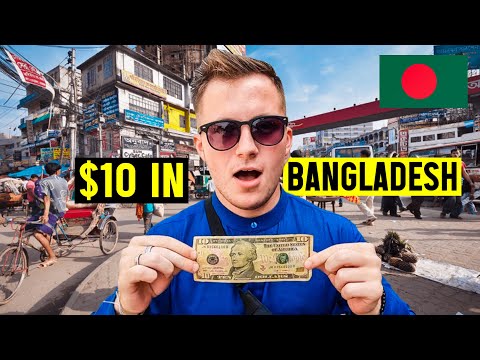
From Chaotic $10 Challenge in Dhaka, Bangladesh 🇧🇩
- Ten dollars goes a long way: 1,000 taka bought dessert, a drink, a full meal, a massage and a copy designer jumper, with nothing left over.
- Hospitality does extend to free meals here, contradicting nothing but worth recording: a pulao seller refused payment with “you’re our guest”, which Harry says was the first time it happened to him in the country. He counted the meal against his budget anyway rather than take the advantage.
- Food is cooked centrally and delivered: biryani and pulao arrive at the serving shop in vats made elsewhere in the city.
- Density is the defining experience. He cites 30,000 people per square mile or kilometre — unsure which — and describes being pushed around New Market on a Sunday to the point of being overwhelmed.
- Fish markets are the friendly ones. Harry’s own generalisation from several countries: the people there are the warmest anywhere and nearly every visitor walks past.
- YouTube doesn’t read as a job. Told he makes videos, people assumed he was a student.
- Street ice in drinks comes from the same blocks sitting in the fish market.
From $1000 Luxury Seafront Hotel Bangladesh 🇧🇩
- The country has a beach economy: Cox’s Bazar, around 130 km and promoted as the longest beach in the world, with resorts, quad bikes, jet skis and horses along it. Harry expected a village and found a busy city.
- Domestic flights are short and small-aircraft, out of a Dhaka domestic terminal that is being rebuilt.
- Seafood is the coastal cuisine and Harry got to it late: Bombay duck battered and fried, prawn curry in coconut cream, and dried fish — the pungent market staple, which he doesn’t take to and suspects is an ingredient rather than a dish.
- Breakfast is heavy and spicy, closer to brunch, and his summary of eating in the country is spice at all three meals.
- Sri Lankan food turns up on hotel buffets, kottu included.
From I Survived 24 Hours in Dhaka, Bangladesh with No Money 🇧🇩
- Refusing money is a matter of pride here. A man who had just bought Harry a samosa turned down 10,000 taka — about $100 — outright. Harry’s reading is pride rather than misunderstanding, and he says on camera that he would have taken it himself. Read alongside the tipping note above: this is a country where money is declined for reasons that have nothing to do with generosity toward a guest.
- Gulshan is the modern district, and where the English speakers are.
- The traffic beats every alternative: Harry gave up on getting a lift because walking was faster. A metro was under construction.
- Media reputation versus experience, stated plainly: he arrived expecting the dangerous city he’d read about and puts Bangladesh in the same bracket as India and Pakistan — kind, hospitable, and above all inquisitive, with most of it happening off camera.
- Children from poor districts asked him for food and chose rice, potatoes, flour, salt and milk rather than sweets when he took them shopping.
- Tuk-tuks are caged.
Videos featuring Bangladesh

Video
$1000 Luxury Seafront Hotel Bangladesh 🇧🇩
Harry flies to Cox's Bazar — billed as the longest beach in the world — and stays in a penthouse with its own hot tub, sauna and steam room, then eats his first seafood in Bangladesh.
Video
Chaotic $10 Challenge in Dhaka, Bangladesh 🇧🇩
One thousand taka, one day in Old Dhaka — jalebi, a salted mint lemonade, beef pulao he isn't allowed to pay for, a no-oil back massage, and a Burberry jumper that finishes the budget exactly.

Video
$200 Street Shave in Bangladesh 🇧🇩
A 30-cent pavement shave in Dhaka that Harry pays $200 for, student street food by the university, and an afternoon handed between a chain of shopkeepers who all introduce each other as brothers.

Video
The Most Expensive Hotel In Dhaka, Bangladesh ($200) 🇧🇩
A night at the InterContinental in Old Dhaka — poolside screens, beer in the minibar, 47 Mbps Wi-Fi and a breakfast with a Bengali section Harry rates well above the Western one.

Video
First Impressions of DHAKA, Bangladesh (Busiest City on Earth) 🇧🇩
Harry's first day in the most densely populated city on earth — sugarcane juice off a wasp-covered press, chicken biryani for $1.50, a fish market with a live railway through it, and a cycle rickshaw that outruns the traffic.

Video
I Survived 24 Hours in Dhaka, Bangladesh with No Money 🇧🇩
The no-money challenge with a twist — everyone who helps Harry gets 10,000 taka afterwards — and the first man to buy him lunch refuses the money outright.
Linked from
- Cox's Bazar Place
- Dhaka Place
- Insist on paying Tip