Place
Kyoto
Two hours from Tokyo on a train that averages twelve seconds late — a shrine dating to 706 with over a thousand gates, prayer plaques for a good fishing catch, and a day training with a samurai sword.
Kyoto
Reached from Tokyo on the bullet train — 280 miles in about two hours — and the traditional half of Harry’s fortnight in Japan, travelling with Walid.
The shrine
The most iconic in the country, and one of over 30,000 shrines in Japan.
- It dates back to 706.
- Over a thousand smaller gates climb the mountain. The full walk to the top takes around three hours; Harry does part of it in serious heat.
- Foxes appear throughout and are regarded as spiritual.
- Torii gates, which people of all ages and backgrounds come to, praying for a good harvest, a successful business, and their wishes coming true.
- You wash your hands at the entrance as an act of respect and cleansing — and Harry is honest that he is guessing at the explanation.
- Wooden prayer plaques, on which you write a wish. The printed options are the interesting part and tell you what the culture prays for: traffic safety, a good fishing catch, a good harvest.
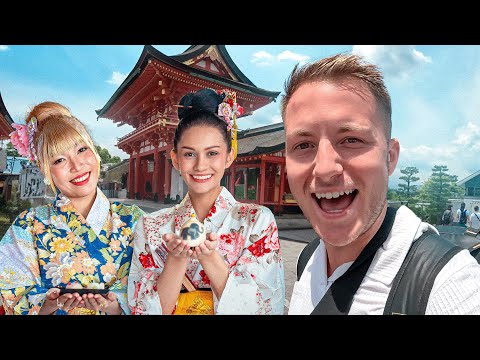
- Women in kimonos throughout, which he stops to admire at some length.
Kendo
He and Walid sign up for a day of it — the martial art descended from samurai training, intended to develop physical and mental discipline.
- Full armour, which Harry finds almost impossible to see or hold his head up in.
- Bamboo swords first, and a bout against each other that he describes as fun rather than hard.
- Then the master, who is far better than both of them.
- Then a real sword, used to cut a target. Harry says only 20–30% of people manage it and that both of them did.
His verdict: much more tiring than expected for a minute of fighting, genuinely good fun, and worth doing again. He credits the tour in the video.
Staying in a ryokan
A traditional Japanese inn, made of wood, with sliding doors, tatami mats and paper screens, and a mix of the traditional and the modern.
- You sleep on the floor on mats, which he is told is better for you — the muscles relax and the hips and spine keep a neutral alignment.
- Shoes off at the door, robes provided, and a Kyoto visitor guide waiting.
- Modern air conditioning and a small but immaculate shower, with what he says is a recurring feature of Japanese hotels: unusually high-quality soap and shampoo.
- Free green tea and water.
- A small meditation area or balcony.
- Everything slides, including the windows. Everything is spotless.
Getting there
- The bullet train’s average delay is twelve seconds, and the fastest ever recorded ran at 375 mph.
- The perspective Harry uses: 80 miles takes two hours where he’s from; here 280 miles takes the same.
- A two-week JR Pass covers it. The Tokyo–Kyoto leg alone would otherwise be about $130.
- The carriage: a window bigger than a plane’s, a tray table, a lot of legroom, power, and wi-fi at around 20 Mbps. Cleaners turn the seats around between services.
- The train does not wait. Harry left his bag on board and only got it back because Walid grabbed it; it was going on to Osaka.
Harry’s tips
- Get the JR Pass before you need it. One leg nearly pays for it.
- Don’t try to walk the whole shrine. Three hours to the top, and it’s hot.
- Do the kendo. He rates it the best thing in the fortnight.
- Sleep on the ryokan floor rather than asking for a bed. It’s the point.
- Get off the train with your bag. It leaves on the second.