Place
Barang
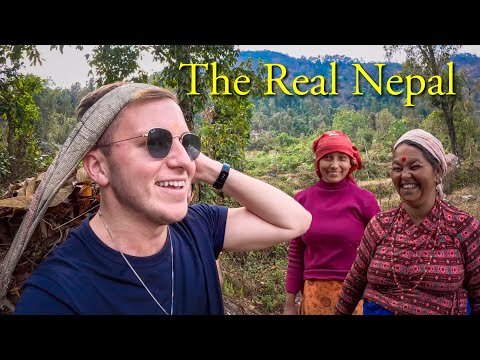
A village of eighty households in the Himalayan foothills an hour from Pokhara, where Harry spent four days — buffalo before dawn, raksi distilled from millet, and a shared-surplus economy he keeps comparing to home.
Barang
A village in the foothills of the Himalayas in Nepal, about an hour from Pokhara and fifteen kilometres from the nearest city, at around 1,500 metres. Roughly eighty households, stacked in levels up the hillside, with more villages visible across the valley and a small town below that has a school but no hospital. Harry stayed four days with a host family.
Obs: the village name is spelled as Harry pronounces it. He names it only in the second of the two videos filmed here.
The landscape is not what he expected of the Himalayas — as much jungle and forest as bare mountain, with barley, rice, cauliflower and potato terraces under fishtail mountain and the Annapurna range.
How the village works
- Surplus is shared. Any of the eighty households can take another family’s spare corn or chillies without asking, because everyone has a surplus of something different. Harry sets this against Western individualism repeatedly and does not pretend to be neutral about it.
- Land passes down the generations, and the idea of encroaching on someone else’s field is, in his host’s phrase, about two hundred years out of date.
- Almost nothing is bought in. Nearly every family has a buffalo and a goat; the food on the plate is grown on the plot; the cinnamon comes off a tree in the forest.
- Everyone produces, including the children. Fourteen-year-olds set fishing nets in the lake before school and sell the catch for around 800 rupees, about five dollars. Harry is careful about how he frames this: his host’s line is that it isn’t child labour, it’s survival.
- Nobody retires. One man of 72 climbs ten metres up a tree to cut fodder, with nobody to help him if he falls. Women in their fifties do the daily climb. Harry’s line is that they stop when they have to.
- No alcohol is drunk in daily life, despite the village distilling it.
- The village has a beekeeper, as every village does.
The daily round
Up before six. The buffalo are given water warmed overnight, then milked; the house is cleaned; the goats — all of whom have names — are taken out. Lunch is cooked by nine. The afternoon is a forty-minute climb into the forest to cut leaves for the animals, carried back downhill on a head strap. Harry tried it and his neck gave out.
Butter is a two-day process: buffalo milk warmed then cooled becomes yoghurt overnight, is churned on a rope-and-pulley churn for over half an hour, drained solid, and boiled down into a clarified butter that keeps a year — the butter poured over dal bhat. Masala is crushed on a stone by hand; there is no blender in the house.
Evenings are communal: neighbours and extended family on a porch for folk songs and dancing.
Raksi
The village distils its own spirit, and the process is worth the visit:
- Millet is fermented for twelve to fifteen days.
- It goes into a large pot sealed over a wood fire, with cloth packed around the join so no vapour escapes.
- A pan of cold water sits on top. The vapour rises, condenses on the cold base, and runs off into a collector.
- The water is swapped out for fresh cold water four times as it heats. Skipping this is what ruins the taste.
Drunk warm, straight off the still, sometimes with ginger. Harry’s description is vodka but stronger, felt the whole way down. It is hours of labour, and the woman making it is a widow supporting three children who will be out farming the same afternoon.
Honey, and other work
The beekeeper harvests comb by hand — ordinary honey, not the mad honey Nepal is known for. Eaten comb and all, which Harry rates the best honey he has had: much richer and stronger than shop honey, hard outside and soft inside. Locally there is also bee-sting therapy, offered for back and bone problems.
Corn is ploughed behind two oxen with a wooden plough; plots too small for animals are turned by hand with a hoe. Potatoes get dug early because monkeys take them. Leopards take dogs and young goats out of the village — one took the host family’s dog during lockdown — and there are leeches in the forest.
Fifteen minutes’ walk away there is a natural waterfall pool, free, and cold enough to be a shock.
Food
Dal bhat twice a day, every day, everything grown within sight of the house. The exception is instant noodles, which Nepal eats a great deal of — Harry is told more per head than almost anywhere — and the very spicy versions are recent, roughly five years old. The local remedy when the chilli wins is sugar and butter, which works immediately.
Jimbu, a herb from the mountains, goes into the dal. Amala is dug up and eaten for dehydration. Strawberries grow below the houses.
Harry’s tips
- Take the homestay rather than a hotel. The routine is the content, and none of it is arranged for visitors.
- Be a morning person. You will be woken at six regardless.
- Carry sugar if you can’t take chilli. It is what the family reach for, and Harry says he wishes he’d known in Sri Lanka.
- Offer to help and expect to be bad at it. He is out-cut, out-carried and out-cooked all four days, and says so.
Source
Videos featuring Barang
Video
96 Hours Living With a Nepalese Family🇳🇵
Four days in a Himalayan foothill village of 80 families — milking buffalo at dawn, churning butter that keeps a year, and a daily 40-minute climb to cut fodder that Harry cannot keep up with.

Video
Local Girl Cooks Me Nepal's Spiciest Noodles🇳🇵
Distilling raksi from millet in a village still, harvesting honeycomb with the village beekeeper, ploughing corn behind oxen, and losing badly to a packet of instant noodles.
Linked from
- Nepal Country