Place
Islamabad
Pakistan's purpose-built capital in the foothills — green, quiet and clean after Karachi and Lahore, and the city Harry arrives in expecting to like and does.
Islamabad
The capital of Pakistan, north of Lahore in the foothills, and the third stop of the 2021 series. Harry arrives having been told it is clean and calm, which is exactly what he wants after two weeks of Karachi and Lahore and a week of being ill.
The first thing he notices is the air. Coming off the bus he says the air feels cleaner and there is nothing like the smog he had been breathing in Lahore — where from a minaret the next district had been invisible. The approach turns mountainous on the way up.
Getting there
The luxury coach from Lahore takes about four to four and a half hours and cost $18 — reclining seats, a fridge, free drinks, an onboard toilet, food at 600 rupees a dish, and wifi at 6–10 Mbps, which Harry points out is better than some of the hotels he had stayed in. There is a fifteen-minute service stop halfway, where the Western fast-food chains are: a KFC box came to 560 rupees, around $4–5, against over 1,000 for a McDonald’s earlier in the trip.
How the city is built
Islamabad is a purpose-built replacement capital — the capital was Karachi before — and Harry’s first impressions are almost entirely about the planning.
- Sectors, not neighbourhoods. Districts are lettered and numbered: F7, F8, F9. Each has a markaz, a central block holding that sector’s shops and restaurants, which he compares to a small mall per district and rates the best thing about the layout.
- Parks were protected as part of the design, and the roads are swept while he watches.
- Tuk-tuks are banned because of the noise — after three weeks of riding them daily elsewhere in the country, the first city without any.
- Security is visible and constant: two police checkpoints and five army positions on one walk, which he reads as seriousness rather than danger.
- His comparison is central Europe, and his advice is to do the cities in the order he did — Karachi, Lahore, then here — because the reverse would make Karachi unintelligible.
The Faisal Mosque
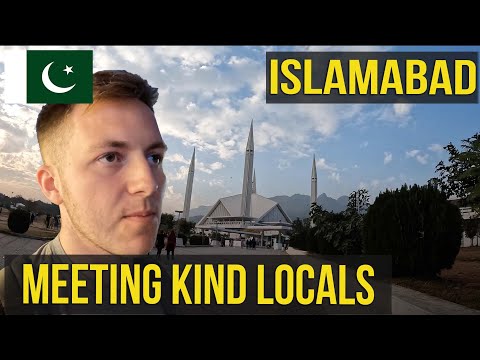
The city’s landmark, at the top of it against the Margalla Hills, and the place every visitor is photographed — see Faisal Mosque for the visit itself, the monkeys on the approach and what an hour of photo requests looks like.
Staying
An Airbnb at about $80 a night, which Harry calls expensive for Pakistan and says outright he overpaid for — poor location, poor value, and chosen because there was little else he wanted. He talks about moving to a hotel instead.
December is cold here, noticeably more so than Lahore and a real change after three weeks of warm cities.
The top of the market
Islamabad’s most expensive hotels run to about $300 a night, and Harry rates the one he used in January 2022 as possibly the best he has stayed in anywhere. What that actually buys, on his account:
- A great deal that is included rather than charged — complimentary minibar, a room phone usable for international calls and as a hotspot, multiple key cards, and a private airport transfer offered when he was about to book an Uber.
- A large buffet breakfast he ranks among the best meals of his trip: Pakistani dishes alongside pastries, porridge, baked beans, an omelette station, and chicken sausages rather than pork.
- A gym, a spa, gardens and a pool — too cold to swim in January.
- Independent shops trading inside the hotel, tailors included, which he notes is standard in big Pakistani hotels.
- Western food at Western-ish prices: about $10 for a pasta dish and a shake.
- Laundry at $3 an item, expensive but fast.
The wi-fi is the catch, and it is a pattern by now. About 6 Mbps at reception, no better through the room phone’s hotspot — worse than the £50 hotel he had used in Lahore. Price and connection speed do not track each other in Pakistan.
The hotel is not named here: Harry appears to have been upgraded and was given the airport transfer, which is the benefit-received trigger.
Eating out
The restaurant districts are modern and stay open late — snooker halls, an Irish cafe, a lot of coffee places, busiest on a Friday, which is the day off.
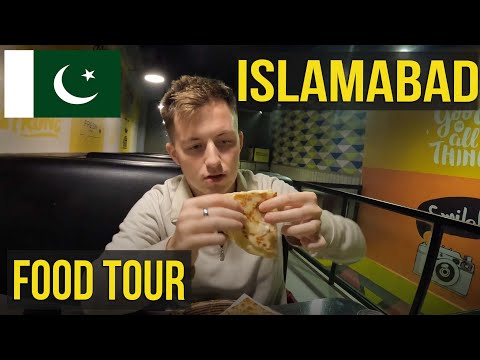
- Cheese paratha, the restaurant version. A 24-hour paratha place does it with mozzarella, cheddar and cream cheese together, thin and crisp with a garlic dip. Harry had been eating the street version for weeks and can taste every cheese in this one.
- Burning Brownie for dessert, on a local recommendation: a cheesecake he rates the best thing he has eaten in weeks despite disliking cheesecake, plus cookie ice cream and a cupcake — just over 1,000 rupees, about $6, for all three.
- A shop called Poundland, pound sign and all, which works because £1 is about 200 rupees.
- Western food is easy to find here and Harry uses it after three weeks of Pakistani food disagreeing with him: pasta and a juice at an Italian place came to about $9, which he calls closer to Western prices and worth it.
- Nitrogen ice cream in the F8 markaz, frozen to order in front of you, about $4 — which he rates above ordinary ice cream purely because it is minutes old.
- Arabian food does well here — chicken mandi, slow-cooked over seasoned rice and not spicy, 1,700 rupees for two, about $9.
- The F7 markaz is the one Harry ends up basing himself around: restaurants, a bakery whose brownies get the strongest reaction of his trip, and a converted house running as a 30-room hotel.
Saidpur
A village absorbed into the city, ten minutes and about $2 away by taxi, and the one place in Islamabad that looks nothing like the rest of it — see Saidpur.
Getting around
Taxis inside the city ran 600 rupees for a five-to-ten-minute ride to F8 and 250 for the way back. Fares up into the hills are a different matter: 2,000 asked against an app price of 895. Harry’s answer was that he was in no rush and would work down the rank until somebody was reasonable — at which point a passing stranger with no stake in it took over the negotiation on his behalf. He paid the 2,000 in the end regardless, on the grounds that the road up is long and steep and the driver who took him had earned it.
The lake and dam area
Outside the city, and the local recommendation for a day out. Boats on the water with fishermen working around them, and on the far side a cluster of four or five small theme parks — no large ones — plus a go-kart circuit and a driving range.
- Carnival entry is 20 rupees. Two rides — a zipline and a Ferris wheel — came to 900-1,000 rupees, about $4 each.
- The zipline runs about 450 feet from roughly 50 metres up, and operates after dark.
- Most of the rides are built for young children; the zipline and the wheel are the two an adult would bother with.
- Getting there is the hard part. Harry’s driver put him at a boatyard on the wrong side of the water, and he covered the rest on the back of strangers’ motorbikes — four up on a main road at one point, and neither rider would take money.
Eating with a view
Monal, up a long run of switchbacks into the Margalla Hills, is the restaurant Harry is taken to and the one he recommends — the whole flat, lit city below it, which he admits the camera cannot capture. Chicken karahi and garlic naan; a chocolate molten lava cake and gulab jamun after. Bags are searched on the door and drones are refused entry.
Getting up there is its own negotiation — see Getting around above.
Wealth, and what he says about it
The housing in the good sectors is better than anything Harry knows in the UK or US, and he says so on camera — along with what follows from it, that the inequality here is severe. He declines to treat that as a Pakistani peculiarity, noting most countries have the same, and he refused to film the houses because filming where people live felt rude to him.
Shopping
The street market is where you kit out for the north, and the prices are the most useful list in the cluster: a thick winter jacket 3,000 rupees (about $16), a shirt 200 (about $1, carrying a British high-street label Harry assumes is fake), gloves 300, socks sold as they come in bulk. Shoe repair at the kerb is 150 rupees and takes ten to fifteen minutes; a shoe shine runs about 100.
Harry’s haggling here is affectionate rather than sharp — gloves talked from 250 to 200 and then paid at 300, because he enjoys the negotiation and liked the seller. He paid 2,000 for the shine.
The Beverly Center in F7 is the indoor alternative: a food court with Western options, where omelettes and smoothies for two came to 2,990 rupees, about $17.
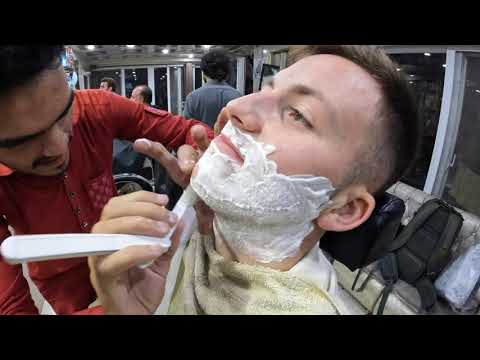
A street shave is 200 rupees at a first-floor shop off the food market — three passes, razor then razor then electric, with cream, aftershave and a wash between. Harry couldn’t find one by looking and got there by asking a sunglasses seller, who left his stall to walk him over and wouldn’t take anything for it.
The copy-goods trade works the same as Karachi’s but quieter — a shop front with a back room for the better fakes. A jacket asked at 2,950 rupees went for 2,300, about $12, against $40-50 for the real thing. The seller’s counter to being pushed further was to offer Harry a cold drink instead of a discount.
Grooming
The most elaborate treatment of the whole Pakistan trip happens here, and it started as a haircut. Ninety minutes, seven or eight stages, and a bill of 8,000 rupees — about $40, plus a 1,000-rupee tip. What that buys:
- A fade and a beard trim, then the most thorough clean shave Harry has had.
- Steam, cleansing cream applied as a face massage, and blackhead and whitehead extraction that makes his eyes water and that he rates as worth it.
- A hydrating stage, a galvanic electric device — a buzz rather than a shock — further massage, and a closing mask.
- The nose cleaned separately, and eyebrows if you want them; without those, Mac paid 3,000.
Harry rates it against the expensive Lahore treatment and can’t separate them. It is not cheap by Pakistani standards and he says so.
How he found it is the transferable part: he searched best barbers rather than barbers near me, and took the top result. The shop confirms the search is where both its tourists and its local customers come from.
The shop is not named here — Harry links its page in the description, which is the trigger for leaving it out.
Source
- Most Expensive Bus In Pakistan 🇵🇰(LUXURY TRAVEL) — https://www.youtube.com/watch?v=yPcs0xJiphU
- Islamabad Cheese Paratha Hunt🇵🇰 — https://www.youtube.com/watch?v=lOleJ-vLSRI
- First Impressions of ISLAMABAD, PAKISTAN (My Favourite City) 🇵🇰 — https://www.youtube.com/watch?v=VfLFIsSP860
- $4 Nitrogen Ice Cream In Pakistan🇵🇰 — https://www.youtube.com/watch?v=Rbr8o0ERYcI
- Why I Love Pakistan (Food Tour Islamabad)🇵🇰 — https://www.youtube.com/watch?v=0FlplbjZZNE
- First Impressions of Rural Pakistan (Saidpur) 🇵🇰 — https://www.youtube.com/watch?v=Lf5aNful4qM
- $300 BEST Hotel in Pakistan (Serena Hotel) — https://www.youtube.com/watch?v=MzPHfSkWhrg
- $45 LUXURY Pakistani Haircut 🇵🇰 — https://www.youtube.com/watch?v=uk2406EO7Kg
- $1 Theme Park Islamabad 🇵🇰 — https://www.youtube.com/watch?v=1gZZXVHkq5o
- BEST Restaurant In Islamabad (Monal) 🇵🇰 — https://www.youtube.com/watch?v=g1fRwTJKcVc
- $36 Pakistan Market Hunt 🇵🇰 — https://www.youtube.com/watch?v=kKKKy4AAVB8
- Honest Pakistani Barber Gets a Reward 🇵🇰 — https://www.youtube.com/watch?v=EhF1qij0ggk
Videos featuring Islamabad

Video
Why I Love Pakistan (Food Tour Islamabad)🇵🇰
Mandi and brownies around an Islamabad markaz, and the clearest statement in the series of why Harry rates the country — help offered with nothing expected back.

Video
$1 Theme Park Islamabad 🇵🇰
A wrong turn to a boatyard, two lifts on an overloaded motorbike, and a carnival by the lake with 20-rupee entry — after being turned away from theme parks twice for not being a family.

Video
Pakistan TRAVEL Q&A (Is it dangerous/ Did I like it?)🇵🇰
Harry answers viewer questions from home after five weeks in Pakistan — the safety question straight, what the trip cost, what he got wrong beforehand, and the one thing he names as a real negative.
Video
Honest Pakistani Barber Gets a Reward 🇵🇰
A three-stage street shave in an Islamabad market for 200 rupees, a 3,000-rupee tip — and the shop owner taking a third of it out of the barber's hand in front of Harry.
Video
My Top 10 Best Moments In Pakistan 🇵🇰
The closing video of the 50-part series — Harry's own pick of the best moments from five weeks, recut from the vlogs, and the index to everything the Pakistan pages were built from.

Video
BEST Restaurant In Islamabad (Monal) 🇵🇰
Dinner up in the Margalla Hills over the lights of Islamabad, a taxi fare argued down by a passing stranger, and friends from Karachi who settle the bill in secret.

Video
$36 Pakistan Market Hunt 🇵🇰
Kitting out for the mountains in an Islamabad street market — a $16 jacket, a $1 shirt, gloves at a dollar — plus shoe repair for 150 rupees and a shine Harry pays twenty times over for.

Video
First Impressions of Rural Pakistan (Saidpur) 🇵🇰
A village inside Islamabad — street cricket, a shooting gallery, a goat on a car roof and breakfast for two for $10 — plus the clearest statement Harry gives of when he uses a guide and when he refuses to.
Video
Islamabad Cheese Paratha Hunt🇵🇰
A first night in Islamabad — an $80 Airbnb Harry thinks he overpaid for, a 24-hour paratha restaurant, and the best cheesecake of the trip for six dollars.

Video
$300 BEST Hotel in Pakistan (Serena Hotel)
Two nights at the top of the Islamabad market after a fifteen-hour drive from Hunza — a room phone that works as a hotspot, $3-an-item laundry, and the video where Harry explains why he needs a VPN to upload at all.
Video
$4 Nitrogen Ice Cream In Pakistan🇵🇰
An hour inside the Faisal Mosque and roughly a hundred photo requests, then liquid-nitrogen ice cream made to order in an Islamabad markaz.

Video
Travelling on the 2nd Most Deadly Road in the World
Twelve hours back down the Karakoram Highway from Hunza to Islamabad — controlled rock blasting, a landslide closure, and Harry and Mac picking their best moments of the whole trip.

Video
First Impressions of SWAT, Pakistan 🇵🇰
The four-hour drive north out of Islamabad to Swat — an ancient Buddhist site the Taliban damaged, a museum that charges to film, and a day spent unable to get cash out of any bank.

Video
$45 LUXURY Pakistani Haircut 🇵🇰
Ninety minutes in an Islamabad barbershop found by googling "best barbers" — a fade, a clean shave and seven stages of facial treatment for 8,000 rupees, about $40.

Video
First Impressions of ISLAMABAD, PAKISTAN (My Favourite City) 🇵🇰
A planned capital of lettered sectors, banned tuk-tuks and swept roads — plus a copy-goods back room, an argument about Lahore, and a troop of monkeys between Harry and the Faisal Mosque.

Video
Most Expensive Bus In Pakistan 🇵🇰(LUXURY TRAVEL)
The $18 luxury coach from Lahore to Islamabad — reclining seats, wifi better than the hotels', a KFC at the service stop, and cleaner air at the other end.

Video
Avoid This Pakistani Man! Karachi Airport Scam 🇵🇰
Flying Islamabad to Karachi for $80 with a meal on a two-hour hop, a 1,000-rupee minimum just to leave the airport, and a porter who carried nothing and would not leave without being paid.
Linked from
- Faisal Mosque Place
- Hunza Valley Place
- Karakoram Highway Place
- Saidpur Place
- Swat Place
- Reward honesty and hard work Tip
- Search for the best, not the nearest Tip
- Akram Person