Country
Pakistan
Harry's observations from his 40+ video Pakistan series — safety, hospitality, food, alcohol rules, and the mountainous north.
Pakistan
Harry spent an extended trip in Pakistan with Mac, producing a 40+ video vlog series, with the mountainous north — the Hunza Valley — saved for near the end.
Observations
From First Impressions of HUNZA VALLEY, Pakistan 🇵🇰
- Safety: locals in Hunza describe an essentially zero crime rate — lost wallets get returned. Harry felt safe leaving bags, drones, and cameras unattended there.
- Culture and people: people are kind and friendly across Pakistan, and especially in Hunza, where strangers chat to you on the street. Harry is learning bits of Urdu — see learn the local language.
- Alcohol: as a Muslim country, alcohol is restricted; non-alcoholic beer is common and can be drunk openly, while regular alcohol is produced in Murree.
- Money and costs: fort entry in Hunza was 1,200 (from video – unverified), about six or seven dollars — Harry finds sights cheap.
- Food: a traditional Hunza meal (noodle soup, thin chicken flatbread, liquid local cheese, green tea) ranked among the best meals of his whole trip.
- Weather: the north is very cold in winter (−7 to −8°C at night in Hunza).
From $140 ULTIMATE FAKE MARKET SPREE (Karachi, Pakistan) 🇵🇰
- Phones and SIMs: the single most useful practical fact from the trip — a foreign handset is blocked from running a Pakistani SIM. The standard workaround is a cheap second-hand local phone; Harry paid $100 for an iPhone 7 in Karachi’s mobile bazaar.
- Hospitality, and the difficulty of it: shopkeepers repeatedly refused his money, sent out for chai while he browsed, and offered to buy him clothes. He found it genuinely awkward rather than charming, said out loud that he could probably shop the whole market for free, and insisted on paying every time.
- Bargaining: nothing is fixed price, including in shops that say they are. Copies are sold in graded tiers — “second copy” cheap, “first copy” good and mechanically closer to the original — and the tier is the first thing to establish before talking money.
- Manufacturing: clothing copies are made in Pakistan from local cotton; watches, pens and leather goods come from China. Sellers say the trade is not policed.
- Food: chana chaat — potato and chickpea in gravy — is a rare vegetarian option in a heavily meat-based cuisine, and cost him about half a dollar. Fresh juice is pressed by hand where there’s no electricity. Chai is far sweeter than anything he is used to.
- Money and costs (2022): a copy polo shirt 400 rupees, a tailored shalwar kameez around 2,500–3,000, a first-copy watch 8,500, a tuk-tuk ride 300, a fresh juice 150, street chaat under 100.
- Emigration: young Pakistanis he met were planning study routes to Europe, Italy in particular.
From I Survived 24 Hours in PAKISTAN with NO MONEY 🇵🇰
- Hospitality, measured: the closest thing in the bundle to a controlled test. Stripped of money in Karachi, Harry got transport from the first car he flagged, food from the first English speaker he asked, and unrequested chai, mocktails and a full biryani from people who refused payment. What he could not get by asking was a bed for the night.
- Language is the real barrier: not hostility, not suspicion. Whole streets he worked spoke no English at all, and every single person who did speak it said yes to him. He rates it the reason the challenge was hard.
- Reputation versus experience: everyone he told about the plan — his parents and his Pakistani friends alike — predicted he would be kidnapped. Nothing of the kind happened, which is the argument the video was made to make.
- Local safety advice was specific rather than general: watch for pickpockets on the Boat Basin food strip, and a residential area described as safe in the morning but not after dark.
- Chai as an institution: drunk late into the night as a social event, in a way Harry contrasts directly with Britain, and at something like ten cups a day for his host. He also notes living rooms arranged so the furniture faces itself rather than a television.
- The 2022 floods: damage still visible along the roads a month or more afterwards. Harry pledged ten US cents per subscriber gained from the video toward relief, targeting $10,000.
- Karachi against Lahore, per his host: Lahore has the better food, Karachi the better people.
From ULTIMATE LAHORE STREET FOOD TOUR 🇵🇰
- Food: Lahore is the food capital, and the day there produces the strongest eating in the series — chana with kulcha, hand-churned lassi from a 1947 recipe, almond halwa, pakora, and Pashtun beef pulao. Much of the best of it is breakfast-only and gone by 2pm.
- Being refused payment, again and at scale: four separate establishments in one day would not charge him. The compromise he settled on — leave it as a tip for the staff — became a page of its own, see insist on paying.
- Family businesses run deep: a lassi shop in its third generation since 1947, a pakora shop 74 years in the same family with the family living above it, and stalls that began as a single cart.
- Jugaar: the improvised fix. A stranger repaired Harry’s trousers by hand at the roadside, and a puncture was patched on the spot for around 200 rupees — his observation being that you are never far from a repair shop anywhere in the country, and that three passing drivers flagged the flat tyre unprompted.
- Religion is not uniform: Lahore has a visible Christian population, which caught Harry out when a Muslim greeting was politely declined.
- Chinese infrastructure: the Orange Line metro, roads and much new construction are Chinese-built. His guide’s explanation is that China wants access to Pakistan’s ports.
- Partition’s traces: Hindu-influenced decoration on Walled City buildings, and a halwa recipe carried from Delhi.
- Regional cuisine: pulao is Pashtun rather than Punjabi, from the tribal areas where beef is preferred to chicken.
- Tobacco and hookah: cured leaf from Khyber Pakhtunkhwa, two to three months in preparation. Hookah survives as an older generation’s institution — one pipe shared round, described as the social network before the internet — while the young have moved to shisha.
From The KINDEST City In The World?! 🇵🇰
- Travel advice versus the ground: Peshawar is on the UK government’s do-not-travel list over extremism Harry places five to ten years earlier. He rates it the friendliest city in Pakistan and the kindest he has been to anywhere.
- Pashtun hospitality is a step beyond what he had already been getting further south, and he had been told in advance to expect exactly that. In one day: a subscriber bought his lunch, a juice seller refused payment, a stranger paid for his haircut and left, and money he dropped in the street was returned to him more than once.
- Appearances mislead: his own summary is that the men who look most intimidating are the kindest, and that older men are wary only because they have never seen a tourist. He is honest about a stretch where the silence and staring unnerved him before someone called him over.
- Physical contact between men: being led by the hand is a friendship gesture and carries no other meaning.
- English drops off sharply outside the big cities — noticeably worse here than in Karachi or Lahore.
- Regional food: beef pulao again, and better — 300 rupees for a portion sized for two, which Harry calls his favourite meal in the country. Eaten cross-legged with shoes off.
- Age and history: Peshawar is the country’s oldest city, dated in the video to 500 BC, and its bazaar was a Silk Road stop for traders arriving from Afghanistan.
- Money and costs (2022): a full barber visit — cut, beard, head massage and facial — 1,000 rupees; pomegranate juice 200; sunglasses 300, with a 50-rupee tourist markup admitted openly.
From $100 Ridiculous Pakistani Street Massage 🇵🇰
- Hospitality, examined rather than admired: the most useful thing Harry says about it in the whole series. He concedes he gets special treatment as a foreign guest with a camera, and answers his own objection with what he has watched Pakistanis do for one another — stopping for strangers’ punctures — with no camera present. The contrast he draws is with England, where he says it simply doesn’t happen.
- Public transport can be excellent: Peshawar’s BRT runs on a segregated road, with enclosed metro-style stations, articulated air-conditioned buses and a women-only section, for 50 rupees a ride. It is the best transport he encounters in the country.
- Ask a person, not a phone: with no internet, directions from locals beat Google Maps outright.
- Street services: a 45-minute massage under a highway underpass for 500 rupees, from a man doing eight a day. Harry paid $100 for it.
- Pashto, not Urdu: in KPK the first language is Pashto, and his few words of Urdu stop being much help.
- Undercutting: a second seller cut across a deal mid-negotiation, and Harry’s instinct was to offer more rather than take the lower price — he wanted the original seller not to lose out.
From Peshawar ULTIMATE Street Food Hunt 🇵🇰
- His favourite Pakistani food, settled: beef pulao, and best in Peshawar. Aromatic rather than spicy, with beef tender enough that he can’t work out how the quality survives being cooked forty pots at a time.
- Trade history: the Qissa Khwani bazaar is named for the traders who came from Central Asia through Afghanistan, did business by day and swapped routes and stories over tea at night. Peshawar was the Afghan kings’ winter capital — nine months here to three in Kabul.
- Cheapest bed in the bundle: rooms above the old tea shop still go for around 100 rupees, about 25 cents a night, and were in use while he filmed.
- Street pitches can be free: a breakfast stall handed down from a father who worked the same spot for sixty years pays nothing to trade there.
- Pre-electric technology still working: a soda house running since 1936 carbonates its own drinks with a hand-pumped CO2 rig and keeps them cold without electricity. Fizzy milk is a Pakistani drink he meets in more than one city.
- Colonial traces and their memory: a 1902 British building still carrying a Union Jack, and a square commemorating protesters shot by British troops, marked every year. The date given in the video is inconsistent and is not recorded here.
- Language surprises: a man switched from Urdu into a fluent London accent mid-conversation, which Harry says threw him completely.
From $0.25 EXTREME Street Shave in Pakistan 🇵🇰
- Street barbers, again and cheaper: a full shave for around 25 cents, performed at speed in front of a crowd of thirty, and a tip refused afterwards.
- The counterweight to everything above. This is the one video in the Pakistan series where the welcome is not simply warm, and Harry says so himself rather than editing it out. The gathering was staged by a local TikToker for his own content; the crowd spent much of it laughing in a language he and Walid didn’t speak; and Harry stepped in off camera to ask them to stop making a joke of Walid being taken for Pakistani. His word for it is awkward. It is worth reading alongside his own caveat elsewhere that a foreign vlogger’s reception is not a neutral measurement.
- Attention has a cost: the crowds that make his Pakistan footage what it is are also, sometimes, an audience being assembled for someone else’s video.
- Street vendor specialisation: barbers work in a row alongside other trades, including a street doctor.
From The Worlds Most Unlivable Megacity That Still Works 🇵🇰
Four years after everything above — the only observation block here from a 2026 visit rather than the 2022 series.
- What changed and what didn’t: the hospitality is unchanged, to the point that app-booked taxi drivers still refuse his fares. What changed is Harry — he goes back to a seller he haggled hard with four years earlier and pays the asking price without negotiating.
- Karachi at scale: 22 million people, the fifth largest city in the world, routinely listed among the least livable. He calls it unlivable and among the most hospitable places he knows in the same sentence, and doesn’t try to resolve it.
- The real danger is the roads. He says it repeatedly and his subscribers volunteer the same answer unprompted when asked what the most dangerous thing in Pakistan is.
- Work and poverty: unemployment in Karachi at 30–40% (from video – unverified), driven by migration from villages to jobs that don’t exist, and absorbed by informal trading where one sale a day can be survival. He states the inequality plainly rather than working around it.
- Education: children he met were studying Quran only — no maths, no school English.
- India and Pakistan: a shopkeeper’s answer about India was hostile, and Harry argued with him on camera — the people are the same as each other, and disliking a government is not disliking a country. The shopkeeper landed on the same distinction. Separately, Harry refused outright to answer a television crew’s questions about the Field Marshal and the fighting with India, saying he doesn’t talk politics.
- Filming etiquette: in the busier Lyari streets he pointed the camera at himself rather than at the women around him.
- How he talks about poor places, stated as a rule: don’t state the obvious, have compassion, imagine having been born there — and don’t sugar-coat, and don’t call something amazing when it isn’t.
- Money and costs (2026): a street shave 300 rupees, two pairs of copy sunglasses 3,500.
The 2021–22 daily series
Everything above comes from the later, longer-format videos. The blocks below are the original 40+ video daily vlog series Harry and Mac filmed from November 2021 — his first time in the country, and chronologically the earliest Pakistan material in the bundle apart from Hunza, which closes the same trip. Where a day’s video is entirely about one city, the detail sits on that city’s page and only country-level observations are recorded here.
From UK tourist travels to KARACHI, PAKISTAN 🇵🇰
- Visas: there is no visa on arrival. Both applied in advance — about five days’ processing for Harry’s British passport, about ten for Mac’s American one. Even with approvals in hand the airline held them at check-in for ninety minutes to confirm them with the Pakistani mission, and they nearly missed the flight. Harry’s advice is to get to the airport very early — see prepare before you land.
- Arriving: Pakistani immigration itself was quick and friendly. Getting in was the airline’s paperwork, not the border’s.
- Driving: traffic drives on the left, and rear seat belts are simply not fitted in the cars he rides in — the beginning of a thread that runs the whole series and ends with him calling the roads the country’s real danger.
- Money: 10,000 rupees out of an airport ATM was about £50 at the time (November 2021). One foreign card was refused and another worked.
From First Impressions of KARACHI, PAKISTAN 🇵🇰
- Buying a SIM is easy and does not mean you have a working phone. About 3,000 rupees for two over a counter, and Harry reports good speeds on the day. Ten days later, on the train north, he says flatly that the SIM does not work: a Western handset will not run it, and the only fix is buying a Pakistani phone, which he refuses to do for a three-week trip. So the handset block that dominates his 2022 visit was already in force in 2021 — he just hadn’t identified it yet when he bought the SIM. The thread finally resolves in Hunza, three weeks later, when a regional provider’s SIM works on the same handset — see the Hunza homestay block below. They were asked to stop filming inside the shop and complied.
- English is widely spoken in the big cities, better than he had just found in Jordan, and it is why his method of asking strangers for directions works at all here. It falls away sharply upcountry, as later videos show.
- Fares are agreed before you board, not after. The only unpleasant exchange of the first day came from getting into a rickshaw without settling the price.
- Dress: at about 30°C in late November, he and Mac were the only people in the street in shorts — noted without anyone objecting, but noted.
- Buses don’t fully stop. Passengers grab a rail and swing on while moving, in traffic with no lane markings.
From Craziest Pakistan Beach 🇵🇰
- British traces are everywhere and he starts listing them: traffic on the left, cricket as the national obsession, and A-levels taught and advertised by name.
- An agreed price is tested rather than binding. 200 rupees agreed for a horse ride became an 1,100 ask and a 500 payment. The lesson he takes is that agreeing first is what gives you something to argue from, not a guarantee — see agree the price before it starts.
- Being filmed by strangers starts here and continues all series: people photographing and filming him in the street, discreetly at first.
- Prices for perspective (Nov 2021): fresh coconut water 250 rupees, a beach buggy hire 200, a short rickshaw ride 250.
From KINDEST Tuk Tuk Driver in PAKISTAN 🇵🇰
- What a tuk-tuk driver earns: about 1,000 rupees a day, roughly five dollars, after seven years in the job — the first wage figure in the series and the one that sets the scale for every price on these pages. Their driver waited outside a café for two hours without being asked and without charging for it; Mac tipped him $12, more than two days’ takings, off camera.
- Ride-hailing exists and is worth checking: Uber quoted about $1.60 for a ten-minute trip, which Harry used as his reference before agreeing a tuk-tuk fare — see haggle with a reference price.
- Ordering coffee: an iced coffee in Pakistan, as in the Middle East, comes closer to a milkshake than to cold coffee.
- Wealth is not far from the centre. Driving out of central Karachi he is surprised by how nice the housing gets, and how quickly.
From Foreigners try Pakistani food 🇵🇰
- Carry your passport. Police stopped them for not having it and, on their host’s reading, were looking for a payment rather than a document. The local advice was to hand over a small amount — 500 to 1,500 rupees (from video – unverified) — and leave rather than argue, because an officer who has been drinking can make it much worse. They ended up paying nothing. It is the first time in the series that anyone in authority is a problem.
- The hospitality, qualified by a local for once. Asked whether a host always pays for a guest here, their companion said it depends on the person — he wouldn’t let them pay, but another local might have paid only for himself. Worth keeping alongside all the entries above where Harry is refused payment: the person who told him not to generalise was Pakistani.
- Public sports facilities are free to walk into: a park beside the national cricket stadium with a running track, javelin, archery and football pitches, no membership and no fee, used by families and by athletes training seriously.
- Giving: children asking for cash got ice cream instead — see buy the thing, don’t give the cash.
From $150 Luxury Pakistan Hotel 🇵🇰
- Ride-hailing beats a tuk-tuk for a reason that isn’t price. About $2 for a ten-minute Uber, much the same as a tuk-tuk — but the fare is fixed in the app, so there is nothing to agree and nothing to argue about afterwards. Harry says outright that the negotiation, not the money, is what he finds difficult.
- Luxury hotels are fortified. Layered vehicle barriers, watchtowers and a check at the gate before a car reaches the door. He notes it without alarm and says the reason is obvious.
- Drones need permission even from your own hotel balcony, and it can be granted — a manager cleared him to fly, but not from the roof.
- Hospitality at the top end works the same way as on the street: a passing remark that it was his birthday produced a cake, a card and a room upgrade within the hour, and a remark about wanting a sleeper train produced a staff member queueing for hours at the station to buy the tickets. Nobody was tipped or asked.
- Pork: sausage at a hotel breakfast in a Muslim country is not pork, and he says it is noticeable.
From Cheese Paratha hunt in Karachi 🇵🇰
- Why nobody lets him pay, explained by someone doing it. Three strangers tried to buy one meal in an evening, and one of them said why: it is what a Muslim family does for a guest, giving is the better half of the exchange, and Harry accepting is what makes it good for the giver. It is the counter-argument to insist on paying, delivered on camera by the person being insisted at, and Harry’s response is that he wants to start doing it at home.
- Tuk-tuks are on Uber, at 280 rupees for a cross-town ride — the app fare removes the negotiation entirely, which by now is Harry’s stated preference.
- Finding a specific dish is harder than it looks: several restaurants claimed to have cheese paratha and one insisted it wasn’t sold in the area at all. His fallback — go wherever is busiest — is what found it.
From Exploring Modern Pakistan 🇵🇰
- The day runs late, and children run with it. A modern leisure complex at ten at night full of families with small kids; the family he asked said they go to bed around three. He compares it directly with British bedtimes and treats it as a difference rather than a failing.
- There is a modern, moneyed Pakistan and he goes looking for it here: waterfront restaurants, clothes shops, rides and performers, priced at 200 rupees to walk in. He would not have found it without a local suggesting it.
- A posted price can move. The boat ticket was 250 before they arrived and 350 when they paid. He records the change and declines to call it anything.
- Eating out at the mid range: a full kebab dinner for six — chicken, beef, breads, salad and chutney — came to about $25.
From Westener In Pakistans Biggest Market 🇵🇰
- Security is visible and Harry reads it as reassurance. Heavy police and army presence across Karachi, which he says makes the city feel safer rather than more dangerous, alongside what locals told him: five years earlier it was ranked among the most dangerous cities in the world and by 2021 it wasn’t. His own exception, then as later, is the driving.
- Sellers can be scrupulous about what they’re selling. Asked whether a ring was silver, the stallholder said stainless steel immediately and unprompted — the thing Harry singles out about the whole market.
- He is not good at haggling and says so. Paying 3,000 for a shalwar kameez asked at 5,500, his own summary is that the seller was better at it than he was and that he was happy for him to have the sale. Worth having on the record next to haggle with a reference price, which is a rule he states more often than he manages to follow.
- Air quality is a real cost. Visible smog over Karachi, and older tuk-tuks routing their own exhaust into the passenger seat.
From Foreigner Meets Crazy Pakistani Locals🇵🇰
- Bag security at monuments is absolute. At the national mausoleum the rule was no bags at all rather than searched bags, so his stayed with police at the gate and he filmed on a phone. Harry rates Pakistan the strictest country he has been to for taking cameras and bags into places, alongside the UAE, and attributes it plainly to terrorism.
- The evening flag-lowering ceremony at the mausoleum draws a crowd and is worth timing a visit for.
- The tourist price is real and he stops fighting it. Dinner at 2,100 rupees against a 1,160 figure he had seen; he names it as a foreigner price, pays it, and says it isn’t always worth arguing over.
- Water is the thing to check before a long journey. He couldn’t establish whether a juice was made with filtered or tap water — the language gap beat the question — the night before an eighteen-hour train.
From $100 Overnight Train to LAHORE 🇵🇰
- The Karachi–Lahore sleeper takes 17 hours on the Green Line, and Harry rates it worth doing over the flight — not for the price, which is comparable, but because it is the only way he sees the country between the two cities. Business class means a six-berth cabin with fold-down beds, a fan, power sockets and a screen; buying it out for two came to about 36,000 rupees, near $200. Stations stop for roughly five minutes.
- Don’t eat or drink what comes down the carriage. He was told this by several locals, took the advice, boarded with packaged snacks, and refused breakfast twice. He also bought a Pepsi off a hawker whose cap was already loose and didn’t drink it — a refilled bottle is the thing to watch for.
- Ticketing can be bent, in front of you. A station clerk reissued their fare as two adults and four children to reach a cheaper rate and kept part of the difference: 44,000–45,000 became about 36,000. Harry and Mac describe the mechanism on camera rather than treating it as a bargain.
- The smog has a cause and it isn’t only traffic. Rubbish is burned along the route because there is no collection system to take it anywhere, which is what they are looking at through the window for most of a day.
- Rural Punjab from the train: farms, palm trees, half-built houses, animals on the line, army bases with watchtowers, and an onboard kitchen assembling something like 290 meals by hand.
- Nothing is booked more than a day ahead — stated here as a three-week policy, see book nothing in advance.
From BEST Hotel in PAKISTAN ($200/night)🇵🇰
- Internet, with a benchmark. 9.3 Mbps in a top-end hotel room in 2021, and a Lahore co-working space quoting 6–8. That is the scale to expect rather than the number itself.
- There is an expensive Pakistani cuisine and Harry hadn’t met it: three courses for two at about $40, versus the 700-rupee street meals filling the rest of these pages. He notes in the same breath that it remains a lot of money for most Pakistanis.
- Edible silver leaf on desserts — laid over a set saffron pudding. Tasteless by his account, and there for the appearance.
- Hotel security escalates with the hotel: three lanes of checks, armed guards and dogs on the vehicles before the entrance in Lahore, against the watchtowers and barriers in Karachi.
- Winter is regional. December in Lahore is 20–25°C by day and 10–15 in the evening, where Karachi was around 30 — and the Hunza entry above has nights at −7. The north is a different climate, not a cooler version of the same one.
From First Impressions of LAHORE, PAKISTAN🇵🇰
- Cricket is the national fabric, not just the national sport — played in the street, in every park, three games at once on one patch of grass, with soft balls and improvised stumps. Harry plays and is comprehensively beaten by teenagers.
- The foreigner price is common enough that an honest quote is remarkable. Given the ordinary 200-rupee local fare by a Lahore tuk-tuk driver, Harry paid 1,000 and said plainly why: he had been overcharged repeatedly since arriving and wanted to reward the one man who hadn’t tried.
- Lahore’s transport infrastructure is a step up from Karachi’s — bus lanes and a functioning system rather than improvisation.
- What Pakistanis ask a foreign visitor, over and over: do you feel safe here, and would you recommend this country to other tourists. It is the question behind the whole series.
From $8 Tour of LAHORE, PAKISTAN 🇵🇰 and Trying DELICIOUS Pakistani Food 🇵🇰
- Mosques enforce a men’s dress code at the door: trousers or jeans, and shorts will lose you the visit — see cover up in conservative countries.
- The tourist price is stated openly rather than hidden. A rickshaw tour quoted 1,500 in the morning was 2,500 in the afternoon, and the answer to “why?” was because we’re tourists, brother. Read that alongside every entry above where someone refuses to let him pay at all: both are normal here, from different people, sometimes on the same street.
- Being photographed is the constant cost of being foreign. Around a hundred requests in an hour at the mosque, and a queue forming on the food street. He and Mac printed business cards for about £5 to hand out rather than typing a channel name into strangers’ phones.
- Markets outside the tourist economy sell nothing to tourists, which is the reason to walk them. The Delhi Gate market in Lahore is clothing, cashmere, clocks and nuts for residents, and Harry gave up on finding a souvenir there.
From $170 Tailored Suit In Pakistan 🇵🇰
- Tailoring, with numbers: a made-to-measure suit asked at 45,000 rupees and bought at 30,000 — about $178 — against roughly 30,000 for the same shop’s ready-made. Three to four days, deposit up front, balance on collection, Pakistani fabric, made in Lahore.
- Only owners discount. Told to Harry plainly by the two men who turned out to own the shop: staff have no authority to move a price at all. It explains why some negotiations in the country go nowhere and others move 15,000 rupees in a minute.
- He priced it against England, not against Pakistan, because he had no local reference — and says afterwards that he paid for convenience and probably went the wrong way. Another entry for the honest column: he is clearer about losing a negotiation than most people are about winning one.
From Tourists at India & Pakistan Border 🇵🇰
- Foreign cards work at very few banks, and the answer changes city to city. Neither Harry’s nor Mac’s card worked at any machine they tried in Lahore, including one bank whose ATM had worked for them in Karachi days earlier. The one that eventually paid out was Standard Chartered, with a 20,000-rupee cap per withdrawal. Plan cash around this: he calls it a problem he has had in no other country.
- The Wagah border ceremony runs daily, all year, and is worth the 40 minutes from Lahore — thousands of spectators on each side and a performance staged directly at India.
- Phone signal is cut at the border, and the approach carries repeated military checkpoints. His hotel recommended a security guard for the trip; Harry’s own conclusion afterwards is that a local or a guard mainly saves you time at the checkpoints.
- The India relationship, as staged: two armies doing the same choreography at each other every evening for decades, which Harry reads as cooperation dressed as hostility. Compare the Karachi shopkeeper in 2026 who was hostile about India until Harry argued with him.
From $100 Haircut in LAHORE, PAKISTAN 🇵🇰
- Barbering runs from 25 cents to $95 in the same country. A four-hour luxury grooming package in Lahore — fade, clean shave, seven-stage facial, manicure and pedicure — came to 17,400 rupees, roughly $95 (from video – unverified). The street version of the same shave, a year later in Peshawar, is 25 cents.
- Hygiene at the top end is exceptional: every tool soaked in disinfectant between uses, which Harry calls the cleanest he has seen anywhere.
- What a local barber says about safety, unprompted: Pakistan is safe now, ten years ago perhaps not, and people here look after visitors. It is the same five-year-improvement story he was told in Karachi, from a different city and a different trade.
- Chai beats English tea, per Harry, who notes he is English and says it anyway.
- Alcohol: not legal for Muslims, and he refers to a room in his hotel where it can be had (from video – unverified — the transcript garbles the word). Read alongside the Hunza entry above on non-alcoholic beer and the Murree brewery.
From Exploring Modern Lahore, Pakistan 🇵🇰
- Internet speed does not follow the room rate. The best connection Harry found in ten days in the country was 20–30 Mbps at a £50-a-night hotel in Gulberg — against 9.3 Mbps at the $200-a-night place. If you need to work, ask about the wifi rather than paying up for it.
- Foreign food exists in the modern districts and he uses it: ten straight days of Pakistani food and they went for Lebanese, at about $14 for two, in a strip of upmarket restaurants and rooftop cafes.
From $18 Go Karting In PAKISTAN🇵🇰
- “Families only” is a real admission policy, and two men will be refused at the gate. It happened to Harry and Mac twice, most clearly at a Lahore theme park where the manager heard them out and still said no. He respected it and left. Worth planning around: leisure venues here are built for families and some enforce it literally.
- Checkpoints treat passports differently. At an army checkpoint outside Lahore only Mac’s details were taken, not Harry’s, which Harry attributes on camera to Mac being American rather than British.
- The driving, quantified at last: three or four real near-misses per journey by his count, and two or three actual crashes seen in a fortnight. It is the same conclusion he reaches in 2026 — the roads are the country’s real danger — arriving here for the first time.
- Costs for a day out: go-karting about $18 a head for fifteen minutes.
From Foreigners Explore Old Town Lahore🇵🇰
- The smog is not fog and it is severe. Harry spent his first days arguing it was fog; from a minaret in Lahore the buildings a few hundred metres away are invisible. Read with the rubbish-burning explanation from the train journey above.
- Drivers frequently don’t know the way and will accept the job anyway, then stop three, four or five times to ask strangers for directions — which strangers always give. Budget time rather than expecting a direct route.
- Mosque etiquette: shoes off, trousers on, and Friday outside prayer times is the quiet window rather than the busy one.
- Illness happens. Harry lost two days of the trip to it, and had already been avoiding anything made with local water.
From Most Expensive Bus In Pakistan 🇵🇰(LUXURY TRAVEL)
- Intercity coaches are the good way to move around. Lahore to Islamabad on the top-tier service is about four and a half hours for $18 — reclining seats, fridge, toilet, drinks served, and onboard wifi at 6–10 Mbps, which beats several of the hotels on this trip. An ordinary bus would be $5–10.
- Service stops are fifteen minutes, which is not as long as it sounds, and the Western chains are there: a KFC box 560 rupees against over 1,000 for a McDonald’s elsewhere in the country.
- Islamabad’s air is the immediate difference. Stepping off the bus after Lahore’s smog, the first thing Harry says is that he can breathe.
- Advice comes from fellow passengers. The man beside them on the coach grew up in Skardu, spent the journey briefing them on the north, and then drove them to their accommodation with his cousin for nothing.
From Islamabad Cheese Paratha Hunt🇵🇰
- The exchange rate to hold in your head (Dec 2021): £1 ≈ 200 rupees. Harry works it out off a shop called Poundland and it makes every other figure on these pages readable.
- Friday is the day off, which he keeps re-learning: restaurant districts are at their busiest and the working week is arranged around it.
- Accommodation gets worse value the further from the tourist trail you go. An $80-a-night Islamabad Airbnb he considered poor value, against $50 for a two-bedroom in Karachi and £50 for a good Lahore hotel room.
- The north is properly cold in December. Islamabad after Lahore is the second step down in three days.
From First Impressions of ISLAMABAD, PAKISTAN (My Favourite City) 🇵🇰
- The capital was moved to a city built for the purpose. Islamabad replaced Karachi, is laid out in lettered sectors each with its own commercial markaz, protects its parks by design, and bans tuk-tuks for noise. It is the one place in the series where nothing is improvised.
- Do the cities in ascending order of order: Karachi, then Lahore, then Islamabad. Harry says the reverse would make Karachi incomprehensible.
- Regional rivalry is real and good-natured. Lahoris told him Lahore Lahore hai — there is no competition — while conceding Islamabad has the better traffic and airport. The claim they don’t concede is the people.
- Monkeys are a genuine hazard on the trails around the Faisal Mosque: one charged Harry while he filmed it, and locals told him they attack in groups.
- Western food is available in the capital at nearer Western prices, about $9 for a pasta dish and a drink, which he used deliberately after three weeks of local food upsetting his stomach.
From $4 Nitrogen Ice Cream In Pakistan🇵🇰
- At a landmark, expect to be photographed constantly. About a hundred people in an hour at the Faisal Mosque, twenty of them within minutes. Harry’s advice to Western visitors is to expect it wherever tourists gather and to read it as friendliness — with the honest rider that some of it is very full-on.
- Mosque logistics: shoes off into a cloakroom, and at a government site getting them back is slow.
- Rewarding an honest fare is now a habit rather than a moment — 250 rupees quoted for a taxi, 1,000 paid, for the same stated reason as in Lahore.
From Why I Love Pakistan (Food Tour Islamabad)🇵🇰
The series’ thesis statement, delivered four weeks in.
- What he actually rates is help offered with nothing expected back — directions given, and then the person walking him to the shop. He is precise about the conclusion: not that Pakistanis are individually exceptional, but that it is built into how people are raised here.
- He states the gap between that and Western media coverage outright, and says the point of being able to travel and film here is to close it. It is the clearest version in the cluster of the argument judge a place for yourself is built on.
- He does not soften the inequality. The housing in Islamabad’s good sectors is better than anything he knows in Britain or America; the gap that implies is severe; and he refuses to treat it as peculiar to Pakistan rather than normal almost everywhere.
- He wouldn’t film the houses, on the grounds that filming where people live is rude — the same instinct as pointing the camera at himself in Karachi’s busier streets.
- Colonial leftovers, continued: British-looking police cars, added to driving on the left, cricket and A-levels.
From $1 Theme Park Islamabad 🇵🇰
- Family-only admission, third instance — and the workaround. By this point two theme parks have turned Harry and Mac away for not being a family; they get into a third by explaining that they are brothers, and an attendant waves them through. So the policy is real, common, and applied by people rather than by a turnstile.
- Leisure is extremely cheap at the bottom of the market: 20 rupees to enter a carnival, and about $4 a head for the two rides worth doing — against $18 for the Lahore go-karting.
- Lifts from strangers are offered and never charged for. Two motorbike rides, four people up on a main road at one point, and the answer to an offered tip was that it was his duty and they were his guests.
From BEST Restaurant In Islamabad (Monal) 🇵🇰
- Strangers will negotiate on your behalf. Faced with 2,000 rupees asked against an app price of 895, Harry started working down the taxi rank — and a passer-by with nothing to gain took the argument over for him. It is the hospitality pattern applied to money rather than to food.
- His stated method, in one line: I’m in no rush, so I can talk to everyone until I find the right price. Read against haggle with a reference price, which is the same technique with the app supplying the number.
- Drones are refused at restaurant doors too, not only at monuments — bags are searched going in.
- Being paid for, again, and this time invisibly: friends from Karachi who had travelled up settled the bill during dessert without saying anything, so Harry never learned what the meal cost.
From $36 Pakistan Market Hunt 🇵🇰
- You can kit out for the mountains on the street for about $20. A thick
winter jacket 3,000 rupees (
$16), a shirt 200 ($1), gloves 300. Buying warm clothes in Islamabad before going north is cheaper and easier than carrying them. - Kerbside trades and what they charge: shoe repair 150 rupees in ten to fifteen minutes, a shoe shine around 100. A shoe cleaner working a market pavement told Harry the work pays about 500 rupees a day — the second wage figure in the series, matching the Karachi tuk-tuk driver’s almost exactly.
- His haggling is social rather than economic, and he says so: he talked gloves from 250 to 200 and handed over 300, because he enjoys the negotiation and rated the seller. Read that against the tip pages, which describe a technique he only half uses.
From Honest Pakistani Barber Gets a Reward 🇵🇰
- A street wet shave is 200 rupees and comes in three passes — razor, a second razor for what the first missed, then an electric razor. Harry’s reason for bothering is that it lasts about twice as long as shaving himself.
- A tip handed over in someone else’s shop gets split. He gave 3,000 on a 200-rupee shave and watched the shop owner take 1,000 of it out of the barber’s hand. He didn’t object — it is the man’s shop — and the barber still went home with roughly double a day’s pay. It is the only place in the bundle that follows the money past the moment of giving.
- Asking beats looking. He couldn’t find a street barber at all until he asked a sunglasses seller, who left his own stall to walk him there and refused payment for it.
From First Impressions of SWAT, Pakistan 🇵🇰
- Foreign cards work in two banks and nowhere else, and that is a problem the moment you leave the three big cities. Harry and Mac travelled north to Swat with no cash on the assumption they could withdraw on arrival, and spent an afternoon failing at bank after bank — including one that had worked for them in Karachi and not in Lahore. Draw cash in the cities before going north.
- Western Union is the fallback, and it is not a complete one. Of $400 changed there, $200 was refused as not eligible with no explanation given. Harry’s own conclusion, said on camera, is to always carry notes in his home currency — the first time in the series he states a rule rather than describing a day.
- Swat was under Taliban control from 2007 to 2009, per the guide, and the Buddhist site above the town still carries the damage. There is a passport check on the road in; the American passport draws the interest, courteously.
- The road north is good. New tarmac and tunnels through the mountains for the four hours from Islamabad — though Harry passes a truck that has gone off the side of one.
- Museums may allow filming and price it separately. Entry to the Swat museum was about 200 rupees a head; the filming fee was high enough that they paid the ordinary ticket and put the camera away.
- A bottle of water handed to you is not automatically safe. Mac stopped Harry drinking one given by a shopkeeper, on the grounds that he had already been ill once on the trip.
From Delicious Food Tour in SWAT, Pakistan 🇵🇰
- Northern towns are zoned by trade the way Harry remembers Jordan being — a whole quarter of Swat’s bazaar is car repair, known regionally for cheap wheel rims. Useful for finding a service: go to the quarter, not to a shop.
- Two large meals and four chais for 830 rupees, about $4.50, at the local price. Restaurant portions across the country are large enough that Harry says there have been very few meals in Pakistan he has finished.
- Winter restaurants in the mountains seat you in individual heated huts rather than a dining room — for privacy and for warmth, the staff say, and both are true in January.
- Local dress does not make a foreigner unremarkable here. He bought a piece of local winter clothing for 500 rupees and wore it straight out of the shop, and was stared at more than before; the tactic that worked in Saudi Arabia doesn’t transfer. See wear the local dress.
- Assume no wi-fi in the far north. Harry and Mac spent the Swat evenings editing to bank uploads before Hunza, on the assumption they would lose connectivity there.
From Road Trip to HUNZA VALLEY🇵🇰 (Part 1)
- The drive from Swat to Hunza is quoted at ten to twelve hours and is mountain road nearly all of it — a route that would be short as the crow flies and takes a day because it winds. There are flights from Islamabad, Harry is told, but very few of them.
- Foreigners on this road get armed police escorts, handed over district by district. What starts as a routine checkpoint becomes two officers and a driver with AK-47s taking them through a town “for their own security”, then releasing them to the next escort at the boundary. Nobody explains why on the day; the reason arrives the next day, in Part 2.
- Checkpoints here are hospitable. Officers share biscuits and chai while the control room is called for clearance, and Harry has nothing bad to say about any of it — his discomfort is with not knowing the reason, not with the treatment.
- Drone permission is granted by asking the escort. They said yes; in the next stretch Harry assumes the answer would be no and doesn’t fly. Compare the drone refusals at monument and restaurant doors further south.
- Breakfast on the road is paratha with yoghurt and very strong chai, which is what everyone else in the roadside restaurant is eating.
- Timber is the visible export of the lower valley — convoys of decorated trucks carrying it south.
From We Had 19 Police Escorts - Hunza Road Trip🇵🇰 (Part 2)
- The escorts on the northern road exist because of a Chinese-built hydropower dam. There had been an incident involving a Chinese worker at the plant (from video – unverified — Harry states he doesn’t know exactly what happened), and since then foreigners on that stretch are escorted as standard. It is also why patrols are plentiful: the Chinese workforce already needs them. 21 checkpoints and 19 escorts between Swat and Hunza, turning a twelve-hour drive into fifteen.
- Take the escorts as precaution, not as a threat assessment. Harry’s conclusion once he learns the reason is that they were courteous throughout and that the discomfort was in not being told why — the same reading he gives the security presence everywhere else in the country.
- Near the Chinese border the food changes. Roadside stops sell mutton dumplings and rice dishes that are a genuine Pakistani-Chinese mix; 1,000 rupees fed four people, about $5–6.
- Mountain hotels run on generators, so the heaters may be unusable, and the wi-fi with them. Assume no reliable connection in the far north and plan around it rather than expecting to work there.
From $8 Designer Shoes in Northern Pakistan 🇵🇰
- Hunza was a separate kingdom until Pakistan took it over, and the tour of Altit Fort is where the bundle’s account of that comes from: a line of kings ending with Jamal Khan, whose son is still alive at 75 and whose family still lives in the valley.
- Seven languages are spoken in the Hunza area, and Harry is told people there know all seven.
- The absence of police is itself the safety evidence. After a week of armed escorts on the road, there is barely a police presence in the town, which Harry takes as confirmation of what he had only been told.
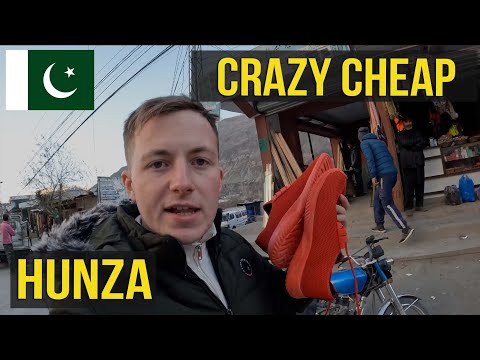
- There is a street repair economy, and it is priced by trust. A pavement handyman fitted a new zip to Harry’s jacket in minutes, trying sizes until one worked, and named no price at all — Mac paid 500 rupees because they felt like it. The word for the work is jugaar, glossed for Harry as “options”.
- The same man then upsold him a pair of trainers for 1,200 rupees, about $7. Harry called them designer on camera and corrected himself in the description after looking properly. The transaction is the point rather than the brand: he came in for a zip.
- School finishes at 2:20pm in the valley.
From Crazy Glacier in Hunza Valley🇵🇰
- Northern Pakistan is worth visiting in winter, which is the question Harry says he is asked most about Hunza. Summer is the obvious season; winter is just as good if you know it is −7 to −9°C in the evening and about 2°C by day, and that the sun makes it comfortable.
- Hopar Glacier is a ten-minute walk, not an expedition — you park at a hotel and the viewpoint is minutes away. Getting there is the hard part: the last stretch of road is loose rock and barely a track.
- The hospitality is operational, not just warm. Hotel staff carried the wi-fi router into Harry’s room so that he could upload from a valley where the connection is bad — the most concrete instance in the whole cluster of a thing he otherwise describes in general terms.
- Hunza has its own bread and its own crepe, and the breakfast built from them is the one Mac rated the best in the country.
From $80 Northern Pakistan Homestay 🇵🇰
- The SIM thread ends here, and the answer is the provider, not the handset. After nearly three weeks with no mobile data on a SIM bought in Karachi, Harry buys SCOM in Hunza — under $10 for 20 GB — and it works, including in places where nothing else does. SCOM is the regional operator for Gilgit-Baltistan; if you are going to the far north, that is the one to get.
- Cricket is his answer to what surprised him most about the country. Not that it is popular, but that every park and every spare strip of grass has children playing on it.
- Yak is a winter meat in the north. The animals live at 3,000 m and above, go up to the pastures in summer — which is when the meat is hard to buy — and come down when the grass runs out. They are herded, not hunted. One animal is over 100 kg. Eaten as a noodle soup with local cottage cheese, or stewed in apricot oil, which is sweet and savoury at once and unlike anything else Harry eats in Pakistan.
- Hunza food is not spicy, which Harry rates as a welcome break rather than a shortcoming, and it is the food he singles out above everything else in the country: grown locally, and worth the trip on its own.
- Winter rooms in the far north are cold enough to break equipment. Harry’s camera stopped working repeatedly, he thinks from the cold, and breath is visible in unheated lobbies. The under-table heater is the local answer and the thing he praises most.
- Two men travelling together are read as a couple in places set up for couples and families. It happened here over a dinner order; Harry treats it as a language barrier and moves on.
From $6 Jet Ski in Hunza Valley, Pakistan 🇵🇰
- Attabad Lake is twelve years old and was made by a disaster. A landslide on 4 January 2010 blocked the river and drowned a village, whose trees and buildings are still visible under the water. The tourism economy of upper Hunza — boats, hotels, restaurants — dates entirely from it, and so does the Chinese-built highway that replaced the boat crossing.
- Watersports in the far north are cheap: a jet ski 1,000 rupees (about $6), a boat 4,000 rupees for 20–25 minutes split between five.
- Coming out of season has a concrete payoff and Harry names it: in summer every boat is taken and you queue; in January he walked straight on to both. The trade is that the lakeside restaurants are shut.
- The clearest statement in the whole series of what the trip changed for him: he had no idea Pakistan was even cold, let alone that it had snow-capped mountains and lakes this colour.
From I Can’t believe this is Pakistan 🇵🇰
- Hunza’s own explanation for its long lives: organic, fresh food, yak that eats only grass, and farm work that keeps people active into old age. The guesthouse owner’s grandmother is 97 and fully capable. Recorded as one family’s account. Harry attaches his own cold-exposure theory to it — see use cold exposure and breathwork.
- In the mountains in winter the sun is gone by about 2:30pm. Plan sights for the morning.
- The valley’s oldest settlement has a 400-year-old house with deliberately low doorways, built so that anyone entering bows their head — the same design as at both forts — and a room used for storing dried apricots.
- Hand-loom carpets take about fifteen days each, woven by several people at once from hand-dyed thread. A handmade wallet from the same workshop cost 1,000 rupees, six or seven dollars.
- 1,400 rupees fed five people at a local-food restaurant in upper Hunza — about $10, and the cheapest per head of the whole cluster.
From I Had an Accident at the Most Dangerous Bridge in Pakistan 🇵🇰
- Hussaini Bridge costs 100 rupees, takes a maximum of seven people at a time, and is a genuine footpath before it is an attraction — locals still use it, children run across it. The gaps between the planks are the hazard, not the height.
- Northern Pakistan in January is −5°C on an exposed bridge with river water between 1 and 5°C. Harry’s practical warning is not about falling: it is that you will very likely drop whatever you are holding.
- The honesty claim gets tested on something worth stealing. After Harry’s drone went into the river, Akram posted publicly asking anyone who found it to return it, and said flatly that people here would. It is the same claim the Hunza pages make about lost wallets, applied to a piece of kit worth more than a month’s local wages.
- Drone lesson, learned expensively: after a crash, don’t disconnect. Harry did, which triggered return-to-home, and the drone flew back across the river, ran out of battery over water and was lost.
- What people warned him about before he came — don’t go to Pakistan, don’t eat that, don’t drink that, don’t take tea with locals, don’t talk to locals — and his answer, delivered halfway across the bridge: the fear costs you the trip and protects nobody.
- A hand-beaten coffee at the bridge is 350 rupees. Harry paid 500.
From -20 Degrees at the China - Pakistan Border 🇵🇰
- Khunjerab Pass costs $20 for foreigners and 300 rupees for Pakistanis, going to the national park’s upkeep — one of the few places in the country with an openly two-tier price, and Harry notes it without objecting.
- The China border was closed in January 2022 and no goods were moving through it at all. There is one guard, a line, and a very clear answer about what happens if you cross it.
- −20°C in the mornings up there, and −25 to −30 possible in January. Sunshine in winter is luck rather than the norm, and it is the difference between manageable and not.
- Register with the police before driving to the border — there is a stop for it on the way, and the guides handle it.
- The mountain roads’ real hazard is rockfall, not the driving: ice, frozen meltwater and loose stone across the carriageway, with fresh landslides. Knowing which stretches are bad is a specific thing a local driver has and you don’t.
- Phones pick up the Chinese network at the pass and jump three hours ahead.
- Harry has now been to all three land borders between Pakistan, India and China, and the Wagah ceremony is the only one that is a performance.
From The Pakistan the Media Does Not Show You 🇵🇰
- The good English in the north has a specific cause: the people a visitor meets work in tourism. It is not a general fact about the region, and it does not extend past that circle — which is consistent with English falling away upcountry everywhere else in the series.
- Home cooking in Hunza is a different cuisine again: molida, made of bread and cheese with apricot oil, plus dried fruit from the garden. Houses run on firewood, not electric heating, and families shut rooms up and move down to the city for part of the winter.
- There is no degree in music production or sound engineering anywhere in Pakistan, per the musicians Harry meets, who taught themselves entirely from YouTube.
- Hot springs in the far north are used for back and knee pain, 15 to 30 minutes at a time. Recorded with the caveat the local host attached himself: many people get relief, and it depends what you believe.
From Travelling on the 2nd Most Deadly Road in the World
- The Karakoram Highway now has its own page, built from this video and the two road-trip parts. The short version: twelve hours quoted each way, fifteen northbound once the escorts are counted, and the hazard is rockfall rather than driving.
- The road is deliberately blasted to bring loose rock down, and closes while it happens. Harry got through minutes before one closure; the wait would have been two hours minimum. A separate landslide stop cost five minutes.
- Spring or autumn is the local recommendation for visiting the north — decent weather and no crowds — which is a better answer than the summer/winter choice Harry had been working with. See travel in the off season.
- Roadside hot springs are used for joint pain, twenty minutes at a time. Harry states plainly that the claim is not his.
- Winter in Hunza can mean no running water. −10°C froze the supply and he went two days without washing.
- Mac’s summary of Attabad Lake is the best thing said about it in the cluster: a disaster that buried villages and, over eleven years, became the thing that supports the local economy. Both halves held at once.
From $45 LUXURY Pakistani Haircut 🇵🇰
- The top end of Pakistani grooming is $40 and lasts ninety minutes — a fade, a clean shave and seven or eight stages of facial treatment, against 25 cents for a street shave in Peshawar and 200 rupees for one in Islamabad. The whole range is now in the bundle, and Harry rates the expensive Lahore treatment and this one as indistinguishable.
- An Uber across Islamabad is 250 rupees for twenty minutes.
- Drivers refuse fares too, not just shopkeepers. This one gave up only because the card payment had already gone through — which is the point in the trip where Harry stops treating it as remarkable. His own count by now: four weeks, not one bad experience.
- Search “best X” rather than “X near me”. It is how he found the barbershop, and the shop confirms the search is where its customers come from.
- tk is “theek” — fine, or OK — and is used constantly. Harry picks it up from an Uber driver after mishearing it as TikTok.
From $300 BEST Hotel in Pakistan (Serena Hotel)
- Pakistan is not a monetisable country for a video channel, which is why Harry uses a VPN to upload from inside it — and why the Pakistan videos all go out after he has left. The clearest account in the bundle of what running a channel from the road actually involves.
- The wi-fi pattern holds at the top of the market: about 6 Mbps at a ~$300-a-night Islamabad hotel, against 20–30 at a £50 one in Lahore and 9.3 at a $200 one. Price and connection speed do not track each other here.
- Hotel laundry runs about $3 an item, and comes back fast.
- Big Pakistani hotels house independent shops — tailors among them — as a matter of course.
- Pork is simply absent: sausages at a five-star buffet are chicken.
- Western food at the top end costs about $10 a head — a pasta dish and a drink — which is roughly Western pricing and the point at which Harry starts pre-empting the comments about not eating local.
From First Impressions of Rural Pakistan (Saidpur) 🇵🇰
- Village life is ten minutes and $2 from the centre of the capital. Saidpur sits inside Islamabad and looks nothing like it — goats, wires, street cricket and, Harry says plainly, a good deal more rubbish than he expected.
- Cricket really is everywhere, which the earlier videos claimed and this one demonstrates: several games in one small village, one group batting with a block of wood because they have no bat, and every group happy to hand a stranger the bat.
- Around 15°C in Islamabad in January, and it rains. His warning: do not come to Pakistan assuming it is hot.
- Two full breakfasts for 1,800 rupees, about $10, at the visitor end of a village — cheaper than the city and more food than either of them could finish.
- Why he goes without a guide most of the time, said in answer to the comments and three days after a week of relying on one completely: raw interactions, getting lost, and occasionally getting scammed. See travel with a local guide.
From Avoid This Pakistani Man! Karachi Airport Scam 🇵🇰
- Domestic flights: about $80 for two hours, and a meal is served. Harry has now done the country by bus, train and plane, and the plane is the only one he calls straightforwardly easy.
- Karachi airport has a 1,000-rupee minimum taxi charge, regardless of distance.
- Porters attach themselves whether or not you accept one, at the airport and at the train station. Declining clearly and carrying your own bags does not settle it; Harry paid 200 rupees to a porter who carried nothing. His objection is the principle, and he says the amount is trivial — see be assertive with touts.
- A PCR test can be brought to your hotel room — ten minutes, around $35 in January 2022, arranged at reception.
- Online hotel reviews are not reliable here. The airport hotel with terrible TripAdvisor reviews gave him a clean room and no complaints; the one real wait was because he hadn’t booked.
- His verdict on the country, given before the Q&A that argues it properly: the most intense and enjoyable weeks of his life, hospitality that is not exaggerated, and — wholeheartedly — safe. What he missed and wants to return for: Skardu, Peshawar and Kashmir.
From Pakistan TRAVEL Q&A (Is it dangerous/ Did I like it?)🇵🇰
The wrap-up video, and the only place Harry sets the whole trip out at once.
- The itinerary, as he gives it: Karachi 7 days → overnight train to Lahore, 5–6 days → luxury bus to Islamabad, 5 days → 15 hours by road north, stopping at Swat → 7 days in Hunza → 15 hours back → flight to Karachi. Fifty videos.
- Is it dangerous? His answer, with the caveat he attaches himself: not as dangerous as Western countries claim, he never felt in danger once in four weeks — and he may have been naive, and no country is without bad areas. He adds the temporal version, which is the more useful half: Karachi was not a safe city ten years ago, and places change.
- The visa is the hardest part of getting in. Allow at least two weeks. A PCR test was required in January 2022; he is unsure about vaccination.
- It is not as cheap as outsiders assume. Food is genuinely cheaper; hotels range from cheap to English prices, and he wonders aloud whether security costs explain the top end.
- Go in autumn or spring — his own recommendation by the end, having enjoyed the north in winter anyway.
- The negative he names about the country: road safety. Some cars have no seat belts at all. He calls the complaint hypocritical in his own case, having chosen to ride motorbikes without a helmet.
- His negative about himself: burnout. He filmed through being ill in Lahore to make the most of the time, and says he regrets it.
- The one unpleasant incident in five weeks: Mac was called a terrorist in Karachi. Harry sets it against roughly a thousand people met.
- Crossing the road is genuinely difficult, and the solution was two tuk-tuk drivers taking an arm each across a three-lane highway.
- On being asked to film the malls: a lot of viewers wanted the modern side shown, and he declined the premise — he could drive ten minutes from home for a shopping centre, and came for the markets and the street. He filmed some modern areas anyway so both were on record.
- Food, corrected: he expected far more spice than he found and never met a dish that was too hot for him, which he thinks the vlogs obscured. Hunza food is the best of the trip and among the best he has eaten anywhere; cheese parathas are better in Karachi than in Islamabad; his favourite single dish is chicken biryani.
- Favourite city: Islamabad, and the one he says he would live in.
- Still on his list: Skardu, Peshawar, Kashmir.
- What he thinks the country lacks: proper theme parks — the ones he visited were built for children and families.
From My Top 10 Best Moments In Pakistan 🇵🇰
The closing compilation. Almost all of it is already recorded above; two things are worth adding.
- The sleeper train’s kitchen runs as an assembly line — one man on the chicken, one on rice, one wrapping, one stacking — at roughly a minute a meal and 200 to 300 meals per service. Harry is let in to film it, and it sits oddly against the standing local advice on that route, which is not to eat or drink anything served on board.
- His own ranking of five weeks is the useful part. Asked to pick ten moments from fifty videos, he weights it heavily towards Hunza and towards evenings spent with people — the village studio session, the music-and-dance evening, the barber — rather than towards sights. The one landmark that makes it is the Wagah ceremony.
Videos featuring Pakistan

Video
$6 Jet Ski in Hunza Valley, Pakistan 🇵🇰
A day on Attabad Lake — a $6 jet ski that breaks down and drops him in near-freezing water, a boat he ends up driving, and the drowned village still visible under a lake that is only twelve years old.

Video
I Had an Accident at the Most Dangerous Bridge in Pakistan 🇵🇰
Crossing the Hussaini suspension bridge at −5°C, losing a drone in the river on the far side, and a hand-beaten coffee from a stand that has been there since 2017.

Video
Delicious Food Tour in SWAT, Pakistan 🇵🇰
An evening walk through Swat's bazaar — trade districts, sugarcane pressed to order, a bakery of shortbread biscuits, and dinner for two in a heated tin hut for $4.50.

Video
Why I Love Pakistan (Food Tour Islamabad)🇵🇰
Mandi and brownies around an Islamabad markaz, and the clearest statement in the series of why Harry rates the country — help offered with nothing expected back.

Video
$100 Haircut in LAHORE, PAKISTAN 🇵🇰
Four hours of a luxury grooming package in Lahore — fade, clean shave, full facial, manicure and pedicure — for about $95, and the cleanest barber Harry says he has been to anywhere.

Video
$1 Theme Park Islamabad 🇵🇰
A wrong turn to a boatyard, two lifts on an overloaded motorbike, and a carnival by the lake with 20-rupee entry — after being turned away from theme parks twice for not being a family.

Video
Foreigners Explore Old Town Lahore🇵🇰
The Wazir Khan Mosque and its minaret, reached half an hour late because a ride app sent them to a road with the same name, on a day the smog hides the skyline.

Video
I Can't believe this is Pakistan 🇵🇰
A ruined hilltop fort above Attabad Lake, a 400-year-old house in Hunza's oldest settlement, a hand-loom carpet workshop, and dinner for five for $10 — plus the local account of why people here live so long.
Video
Tourists at India & Pakistan Border 🇵🇰
The Wagah border ceremony outside Lahore — thousands on each side, competing hype men, synchronised flags, and an afternoon spent failing to find an ATM that worked.

Video
Exploring Modern Lahore, Pakistan 🇵🇰
Moving to a £50-a-night hotel in Gulberg with the best wifi of the trip, and eating Lebanese food in Lahore because ten straight days of Pakistani food is enough.

Video
Cheese Paratha hunt in Karachi 🇵🇰
Hunting down a proper cheese paratha at Boat Basin, and the evening three separate strangers try to pay for the meal — with one of them explaining why refusing them is the rude part.

Video
Peshawar ULTIMATE Street Food Hunt 🇵🇰
A full day eating in Peshawar — street breakfast from a stall run for 60 years, forty pots of beef pulao, the city's oldest tea shop with rooms at 25 cents a night, and hand-carbonated fizzy milk from a soda house running since 1936.

Video
Pakistan TRAVEL Q&A (Is it dangerous/ Did I like it?)🇵🇰
Harry answers viewer questions from home after five weeks in Pakistan — the safety question straight, what the trip cost, what he got wrong beforehand, and the one thing he names as a real negative.

Video
First Impressions of LAHORE, PAKISTAN🇵🇰
A first day walking Lahore — a tuk-tuk driver tipped five times his fare for quoting honestly, street cricket, fake Nikes, and tandoori chai.

Video
The Worlds Most Unlivable Megacity That Still Works 🇵🇰
Harry returns to Karachi four years on, in a James Bond framing — Sadar Bazaar, a street shave, an escorted walk through Lyari with a police constable who spotted him, and a subscriber meet-up arranged with four hours' notice.
Video
I Survived 24 Hours in PAKISTAN with NO MONEY 🇵🇰
Harry spends 24 hours in Karachi with nothing, hitching lifts and asking strangers for food, to answer everyone who told him he would be kidnapped — and finds the language barrier is the only real obstacle.

Video
Trying DELICIOUS Pakistani Food 🇵🇰
Old Lahore through the Delhi Gate market, a monkey handler declined on sight, and biryani on a rooftop overlooking the Badshahi Mosque at Western prices.
Video
Honest Pakistani Barber Gets a Reward 🇵🇰
A three-stage street shave in an Islamabad market for 200 rupees, a 3,000-rupee tip — and the shop owner taking a third of it out of the barber's hand in front of Harry.

Video
$100 Overnight Train to LAHORE 🇵🇰
Seventeen hours on the Green Line from Karachi to Lahore in a private business-class cabin — what it costs, how the ticket was fiddled, and why they ate nothing that came off the trolley.
Video
My Top 10 Best Moments In Pakistan 🇵🇰
The closing video of the 50-part series — Harry's own pick of the best moments from five weeks, recut from the vlogs, and the index to everything the Pakistan pages were built from.
Video
$150 Luxury Pakistan Hotel 🇵🇰
Harry's birthday, spent moving into a luxury Karachi hotel — what $150 a night buys, why the security looks like that, and staff who queued for hours to buy his train tickets.

Video
BEST Restaurant In Islamabad (Monal) 🇵🇰
Dinner up in the Margalla Hills over the lights of Islamabad, a taxi fare argued down by a passing stranger, and friends from Karachi who settle the bill in secret.

Video
Road Trip to HUNZA VALLEY🇵🇰 (Part 1)
The first half of the twelve-hour drive from Swat to Hunza — chai stops, timber trucks, and the point where routine checkpoints turn into armed police escorts handed over town by town.

Video
KINDEST Tuk Tuk Driver in PAKISTAN 🇵🇰
A café breakfast, a driver who waits outside for two hours without being asked and then teaches Harry to drive his tuk-tuk, and what he earns in a day.

Video
Why I Travelled the World This Year
The channel's origin story — a 9-to-5 quit in lockdown, a one-way ticket to Dubai, and the Pakistan trip where daily vlogging turned into a job.

Video
$36 Pakistan Market Hunt 🇵🇰
Kitting out for the mountains in an Islamabad street market — a $16 jacket, a $1 shirt, gloves at a dollar — plus shoe repair for 150 rupees and a shine Harry pays twenty times over for.

Video
Crazy Glacier in Hunza Valley🇵🇰
A short hike to a viewpoint over Hopar Glacier, reached by a barely-there cliff road — plus the answer to whether Hunza is worth visiting in winter, and the best breakfast Mac had in Pakistan.

Video
First Impressions of Rural Pakistan (Saidpur) 🇵🇰
A village inside Islamabad — street cricket, a shooting gallery, a goat on a car roof and breakfast for two for $10 — plus the clearest statement Harry gives of when he uses a guide and when he refuses to.
Video
Islamabad Cheese Paratha Hunt🇵🇰
A first night in Islamabad — an $80 Airbnb Harry thinks he overpaid for, a 24-hour paratha restaurant, and the best cheesecake of the trip for six dollars.

Video
Craziest Pakistan Beach 🇵🇰
Sunset at Clifton Beach — coconuts, camels, a beach buggy with no brakes, a horse-ride price that doubled after it was agreed, and a cheese paratha Harry had been waiting for.

Video
$300 BEST Hotel in Pakistan (Serena Hotel)
Two nights at the top of the Islamabad market after a fifteen-hour drive from Hunza — a room phone that works as a hotspot, $3-an-item laundry, and the video where Harry explains why he needs a VPN to upload at all.

Video
The Pakistan the Media Does Not Show You 🇵🇰
Dinner at his guide's family home in Hunza — molida, apricot oil and a Guinness record on the wall — then an invitation to a village recording studio where self-taught musicians play for twenty people.

Video
$18 Go Karting In PAKISTAN🇵🇰
Turned away from a Lahore theme park for not being a family, then $18 for fifteen minutes on a 50mph go-kart circuit — plus an army checkpoint that only wanted the American's passport.

Video
Foreigners try Pakistani food 🇵🇰
A day with a local who won't let them pay for anything — a free public sports park, a race against a Pakistani sprinter, a police stop that wanted a bribe, and Burns Road.

Video
First Impressions of HUNZA VALLEY, Pakistan 🇵🇰
Harry and Mac's first full day in Hunza Valley — a dried-fruit breakfast, a historic fort tour, local Hunza food, and a night of traditional music and dancing.

Video
$100 Ridiculous Pakistani Street Massage 🇵🇰
A second day in Peshawar — Sadar Bazaar, free sweets and chai nobody will let him pay for, the city's modern BRT bus, and a 45-minute massage under a highway underpass that cost $2.50 and earned a $100 tip.
Video
The KINDEST City In The World?! 🇵🇰
Harry's first day in Peshawar — a city his own government advises against visiting — where a subscriber adopts him for the afternoon, nobody will take his money, and a stranger drives him to a barber and pays for his haircut before disappearing.
Video
$4 Nitrogen Ice Cream In Pakistan🇵🇰
An hour inside the Faisal Mosque and roughly a hundred photo requests, then liquid-nitrogen ice cream made to order in an Islamabad markaz.

Video
Travelling on the 2nd Most Deadly Road in the World
Twelve hours back down the Karakoram Highway from Hunza to Islamabad — controlled rock blasting, a landslide closure, and Harry and Mac picking their best moments of the whole trip.
Video
First Impressions of KARACHI, PAKISTAN 🇵🇰
Harry's first full day in Karachi — a rickshaw to wherever the food is, a lift from a politician on a motorbike, a biryani, a rickshaw fare he forgot to agree first, and SIM cards.

Video
First Impressions of SWAT, Pakistan 🇵🇰
The four-hour drive north out of Islamabad to Swat — an ancient Buddhist site the Taliban damaged, a museum that charges to film, and a day spent unable to get cash out of any bank.

Video
ULTIMATE LAHORE STREET FOOD TOUR 🇵🇰
A full day eating across Lahore with a local guide — chana and kulcha, a 1947 lassi shop, a breakfast-only halwa stall, 74-year-old pakoras and Pashtun beef pulao — during which almost nobody will let Harry pay.

Video
$0.25 EXTREME Street Shave in Pakistan 🇵🇰
A 25-cent street shave in front of a thirty-strong crowd — and the one video in the Pakistan series where Harry admits the scene was staged for someone else's TikTok and the crowd's joking turned uncomfortable.
Video
$80 Northern Pakistan Homestay 🇵🇰
Two hours further up the valley to a family-run guesthouse in upper Hunza — yak in apricot oil, a heater under the table, and the SIM that finally works after three weeks without data.
Video
$140 ULTIMATE FAKE MARKET SPREE (Karachi, Pakistan) 🇵🇰
Harry works Karachi's Zainab Market for copy shirts, a tailored shalwar kameez and a first-copy watch, then buys a second-hand iPhone because Pakistani SIMs won't run in a foreign handset.

Video
$45 LUXURY Pakistani Haircut 🇵🇰
Ninety minutes in an Islamabad barbershop found by googling "best barbers" — a fade, a clean shave and seven stages of facial treatment for 8,000 rupees, about $40.

Video
UK tourist travels to KARACHI, PAKISTAN 🇵🇰
The travel day that opens Harry's 40+ video Pakistan series — Amman to Karachi via Sharjah, a visa that nearly cost them the flight, and a 3am arrival.

Video
First Impressions of ISLAMABAD, PAKISTAN (My Favourite City) 🇵🇰
A planned capital of lettered sectors, banned tuk-tuks and swept roads — plus a copy-goods back room, an argument about Lahore, and a troop of monkeys between Harry and the Faisal Mosque.

Video
Foreigner Meets Crazy Pakistani Locals🇵🇰
The national mausoleum at sunset with a flag-lowering ceremony, the strictest bag security Harry has met anywhere, and a cheese paratha he knowingly overpays for.

Video
$170 Tailored Suit In Pakistan 🇵🇰
Having a suit made in Lahore for his brother's wedding — 45,000 rupees asked, 30,000 paid, three to four days' turnaround, and Harry's own verdict that he paid for convenience.

Video
Westener In Pakistans Biggest Market 🇵🇰
Buying a shalwar kameez and a ring at Zainab Market, losing the negotiation and saying so, and a tuk-tuk ride so smoky Harry hangs his head out of it.

Video
$8 Tour of LAHORE, PAKISTAN 🇵🇰
Turned away from the Badshahi Mosque for wearing shorts, a hundred photographs in an hour, and a rickshaw tour whose price rose a thousand rupees because they were tourists.

Video
BEST Hotel in PAKISTAN ($200/night)🇵🇰
What $200 a night buys in Lahore — three lanes of armed security at the gate, a spa, and the first properly expensive Pakistani meal of the trip, eaten under edible silver leaf.
Video
-20 Degrees at the China - Pakistan Border 🇵🇰
Two and a half hours up from Hunza to the Khunjerab Pass — $20 to get in, the world's highest ATM, a closed border with no traffic on it, and the coldest Harry has ever been.

Video
Most Expensive Bus In Pakistan 🇵🇰(LUXURY TRAVEL)
The $18 luxury coach from Lahore to Islamabad — reclining seats, wifi better than the hotels', a KFC at the service stop, and cleaner air at the other end.
Video
$8 Designer Shoes in Northern Pakistan 🇵🇰
A guided tour of an 800-year-old Hunza fort — kings, stone cooking pots and seven peaks from the roof — then a street handyman who fixes a jacket zip and upsells Harry a pair of trainers for $7.

Video
Exploring Modern Pakistan 🇵🇰
Port Grand on Harry's birthday — Karachi's modern waterfront strip, a mangrove boat ride, pani puri, and families out with small children at ten at night.

Video
We Had 19 Police Escorts - Hunza Road Trip🇵🇰 (Part 2)
The second half of the drive to Hunza — 21 checkpoints and 19 armed escorts, explained at the end by a Chinese-built hydropower dam, and a fifteen-hour day ending in an unheatable hotel room.

Video
Avoid This Pakistani Man! Karachi Airport Scam 🇵🇰
Flying Islamabad to Karachi for $80 with a meal on a two-hour hop, a 1,000-rupee minimum just to leave the airport, and a porter who carried nothing and would not leave without being paid.
Linked from
- Altit Fort Place
- Attabad Lake Place
- Baltit Fort Place
- Faisal Mosque Place
- Hopar Glacier Place
- Hunza Valley Place
- Hussaini Bridge Place
- Islamabad Place
- Karachi Place
- Khunjerab Pass Place
- Lahore Place
- Peshawar Place
- Swat Place
- Wagah border Place
- Ask someone who drives for a living Tip
- Book nothing in advance Tip
- Learn the local language Tip
- Prepare before you land Tip
- Travel in the off season Tip
- Use cold exposure and breathwork Tip
- Adil Person
- Akram Person
- Mac Person
- Walid Person