Place
Karachi
Pakistan's largest city and the start of Harry's Pakistan series — the City of Lights, where copies are sold by grade, nobody will let him pay, and he survived 24 hours with no money at all.
Karachi
The largest city in Pakistan and where Harry starts his Pakistan series. His Karachi is the market districts of the old centre: Zainab Market and the streets around it for clothing and copies, and Sada Bazaar a few blocks away for phones. He goes back repeatedly and knows stallholders by sight.
The thing he keeps commenting on is not the shopping. It is that people will not let him pay. A shopkeeper sends out for chai while he browses and then refuses money for the shirt; another offers to buy him clothes; a phone dealer has lassi brought over mid-negotiation. He gets far enough into it to wonder aloud whether he could do the whole market without spending anything, and says plainly that he doesn’t want to — he insists on paying every time, usually somewhere between the offered price and nothing.
Locals call it the City of Lights. His Couchsurfing host’s summary of the national rivalry is that Lahore has the better food and Karachi the better people, and Harry doesn’t argue.
What Harry did
Worked the market for a day with two errands and no plan beyond them: copy shirts off a stall, a shalwar kameez measured and tailored overnight, a first-copy automatic watch and a pen out of a showroom above the market, street juice and chana chaat, and a second-hand iPhone from the mobile bazaar.
On a separate day he spent 24 hours in the city with no money whatsoever — hitching lifts, asking strangers to buy him food, and trying to find a bed.
Four years later he came back a third time, walked the same bazaar, found the same sunglasses seller, and was escorted through Lyari by a police constable who stopped him in the street.
Zainab Market and the copy trade
The market Harry calls the cheapest in the city, selling clothing, sunglasses, belts, watches, food and drink in the same few streets. Copies are graded and priced accordingly, and the vocabulary is worth knowing before you bargain:
- Second copy — the cheap tier. Watches around 3,000 rupees.
- First copy — the good tier, and mechanically closer to the original. A first-copy watch runs about 8,500, just under forty dollars; a first-copy Rolex 12,500, around fifty. First copies are automatics, so they need wearing rather than a battery, which the sellers treat as the proof of quality.
The clothing is not all imported. The Ralph Lauren copies on the stalls are made in Pakistan from local cotton — Harry’s tell for the fake is the embroidered badge — while the watches, pens and Louis Vuitton and Gucci wallets in the upstairs showrooms all come from China. Stallholders told him the government leaves the trade alone.
Prices he paid: a copy polo shirt 400 rupees, about three dollars, after being offered it free; a watch and a Montblanc-style pen together for 2,300.
On the 2021 visit, the same market and a worse negotiation. A two-piece shalwar kameez asked at 5,500 went through 3,800 and 3,500 to 3,000, about £16, and Harry said on camera that he’d paid over the odds, that the seller was better at this than he was, and that he wanted him to have the sale regardless. A stainless-steel ring off a stall was 250 rupees, and he gave another 250 to the man who had walked him to it.
What he singles out about the market is the honesty rather than the prices: asked whether the ring was silver, the seller said stainless steel straight away, and Harry’s comment is that plenty of places would not have.
Getting a shalwar kameez made
Bought by the metre in essentially any colour, cotton or a cotton mix, then measured and tailored — including a choice of how many pockets — with next-day turnaround. Quoted 3,500, agreed at 3,000 once trousers came out of the order, then 500 lower again; Harry called the final figure about $14 (from video – unverified).
Sada Bazaar and the phone problem
The practical fact worth carrying into the country: a foreign handset will not work with a Pakistani SIM. Harry’s iPhone 13 was blocked, which is why he spends the back half of the video buying a phone at all. The workaround is a cheap second-hand local handset, and Sada Bazaar is where they are — six floors of shops, iPhones and Android, new and used, plus a convincing fake Apple Store.
He was quoted 40,000 rupees (~$170), held at $100, walked out, and was called back before he reached the stairs. What he got: an iPhone 7, 32GB, 85% battery, $100, with a two-week warranty and a case. Battery health and the SIM were both tested in front of him before he paid.
The 24 hours with no money
The city is where Harry ran his no-money challenge, and the results are the most concrete measure of Karachi hospitality in the bundle. What he found, in his own order of difficulty:
- Transport was trivial. The first car he flagged down took him across the city despite going somewhere else, and later drivers stopped when he had only waved. His own estimate is ten seconds with a thumb out.
- Food was a coin flip, and only because of language. Nearly everyone he approached in Boat Basin spoke no English at all; the first person who did bought him a cheese paratha immediately. By evening on Burns Road a stranger was ordering him a full matka biryani and a drinks shop was refusing payment for a mocktail he hadn’t asked for.
- A bed was the one he lost. Asking a household to put you up is a different order of request, it doesn’t survive a language barrier, and he notes it lands differently on a family than on single men. He ran out of daylight and used a Couchsurfing host instead — the part of the challenge he says he wants to do without next time.
Two safety notes, both from locals rather than from anything that happened: pickpockets around the Boat Basin food strip, and his host’s line that the residential area they walked into is safe in the morning and not at night.
The city itself
Twenty-two million people and the fifth largest city in the world, routinely listed among the least livable. (On his first visit in 2021 he put the population at around five million (from video – unverified); the 22 million figure is the one he uses later, and the two are recorded as he said them.) Harry’s counter-description is that it is one of the most hospitable places he knows, and he holds both at once rather than resolving them. The words he reaches for are Wild West — nothing makes sense and everything works anyway — and, apologising as he says it, post-apocalyptic.
- The traffic is the actual danger. He says this repeatedly and his subscribers agree unprompted: not crime, the driving. Intersections run without lights, directed by one man with his arms up.
- 40°C, and everybody in a rush, which he compares to London.
- Unemployment around 30–40% (from video – unverified), driven by migration from the villages into jobs that don’t exist. The response is informal trading — a stall, or work for someone who has one, where a single sale in a day can be enough.
- The inequality is severe and he doesn’t soften it. A huge and widening divide, with very little the people in front of him can do about it.
- Keep moving. His own rule for the rougher streets: it’s stopping that makes things sketchy.
- On litter, asked directly: better than he expected, and improving.
- Sport is public and free. Beside the national cricket stadium is a park with a running track, javelin, archery and football pitches that anyone can walk into — families, kids and athletes in training sharing it.
- Carry your passport. The one time authority was a problem was a police stop for not having one, which his companion read as a request for money rather than for a document.
- Police and army are visible everywhere, and on his first visit Harry read that as reassuring rather than alarming. What locals told him in 2021: the city had gone from one of the world’s most dangerous to a livable one inside five years.
- The air is the other cost of the traffic. Visible smog, and an old tuk-tuk with no back panel funnelling its own exhaust into the passenger seat — he finished the ride with his head out of the side.
- Two shopping malls share the same name, which is how a driver with no English delivered them to the wrong one.
Lyari
The district described to him as the most dangerous in Karachi, and he only went because a police constable stopped him in the street, said he couldn’t go alone, and took him personally. Three and a half to four million people live there, with intermittent electricity and gas.
What he found was a market district — spices, vegetables, cheap food — plus gaming shops full of kids on Counter-Strike and a government-funded football stadium going up in the middle of it. A spice seller asked whether life there was good said yes without hesitating. Harry’s only pointed question is what happened to whoever was living where the stadium is.
He filmed himself rather than the street in the busier sections, to avoid filming the women in it.
Staying in the city
Both ends of the range appear in the 2021 series. A two-bedroom Airbnb in Clifton was $50 a night between two — spacious and well located, with a mouse and cockroaches on the third night, which Harry was careful to say he didn’t read as saying anything about Pakistan.
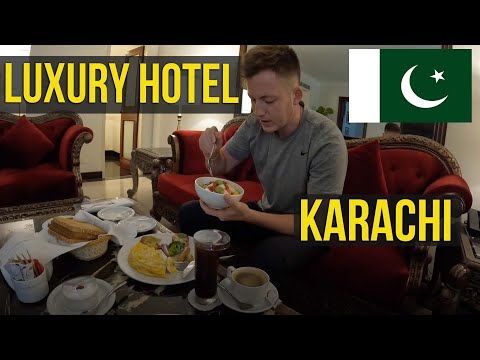
At the other end, a luxury hotel in the centre at around $150 a night. What that bought, at 2021 prices: a suite, a health club with gym, steam room, jacuzzi and a pool from 6:30am, an executive lounge on the upper floors with fruit, snacks and coffee through the day, in-room dining, and a lobby with independent shops in it. Coffee in the lobby café ran 881 rupees for two, about $5.
Two things about Pakistani hotels at this level are worth knowing in advance. The security is heavy and visible — layered vehicle barriers, watchtowers and a check at the gate before a car reaches the entrance. And drone flying needs the manager’s permission, which Harry got, though he was moved off the roof to a lower balcony for it.
The hotel is not named here: Harry paid for the room but was given a free upgrade and other extras during the stay.
Districts
- Boat Basin — the cheap food strip, an hour’s walk from the centre, and where the proper cheese paratha is: thin, crisp and modestly cheesed, not the thick cheese-loaded version he had first. Also where three separate strangers tried to pay for one meal in an evening.
- Clifton Beach — the evening beach, and a whole economy on the sand: coconut sellers cutting to order (250 rupees), camel and horse rides, buggies for hire at 200 rupees a go, and photographers who shoot, colour-grade and print from a stall in minutes. Crowds gather the moment you speak to anyone, and people photograph you from a distance. The horse and camel owners are where prices get tested — see agree the price before it starts.
- Clifton — where the park is; quiet and away from the noise, and where Harry and Mac based themselves on the first visit: a two-bedroom Airbnb at $50 a night between them, about twenty minutes from the airport.
- Burns Road — the evening food street, and where every one of the challenge’s best moments happened. He compares it to Bangkok’s Khao San Road: a strip of independent food shops. Chicken curry cooked over fire with chapati and a cooling yoghurt sauce, 1,230 rupees for two.
- Zainab Market and Sada Bazaar — the shopping and phone districts above. Sadar Bazaar’s surrounding streets are not a smart area but are where the characters are, with British-era heritage buildings still standing among the stalls, and alleys off it holding printers, shoe repairers and paratha shops turning out two a minute.
- The national mausoleum — the city’s monument, busy with families on a holy day, with an evening flag-lowering ceremony worth timing a visit for. Bags are not allowed in at all, searched or otherwise; Harry left his with the police at the gate.
- Port Grand — the modern waterfront strip, and the counterweight to everything else on this page: a pedestrian run of restaurants, shops, rides and street performers along the water, which Harry compares to an outdoor shopping mall in Dubai. Entry 200 rupees, about $1.30, rides extra; a mangrove boat across the water 350. Busy with families and small children at ten at night. A kebab dinner for six came to about $25.
- Lyari — see above.
Street food and drink
- Chana chaat — potato and chickpeas in gravy with mint sauce and a crushed cracker on top, about half a dollar from a cart. Harry rates it among his favourite meals in the country and points out how rare a good vegetarian option is in Pakistan.
- Kettle biryani — chicken biryani cooked in bulk in big kettles at local-only places, served with very sweet chai in a handleless mug. Two meals and two drinks came to 700 rupees, $4–5, on the first day; Harry couldn’t tell whether that included a foreigner premium and said so.
- Matka biryani — chicken and rice layered in a clay pot, sealed, and finished over charcoal so it steams in its own spice. The Burns Road version is the best thing he eats in the city.
- Cheese paratha, the cheap staple he lived on — and Nutella paratha, which he declares an immediate and permanent upgrade. He hunts for his first one across two days of the 2021 series and finds it at a wood-fired naan place: dough rolled flat, loaded with cheese, docked so it doesn’t balloon, brushed with garlic sauce, about six minutes from dough to plate.
- Fruit chai — tea brewed with fruit in it, and less sweet than the standard street version.
- Café coffee, if you want a break from the street: Butlers Chocolate Café produced what Harry called the best coffee he’d had in the country, a spicy three-egg omelette and an Oreo brownie. Two coffees, two meals and the brownie came to 1,600 rupees, which he calls about $20 (from video – unverified) and rates expensive for Karachi.
- Fresh juice — grapefruit and apple through a hand-cranked screw press with no electricity involved, finished with a pinch of salt. 150 rupees, under a dollar.
- Lemon special — a mocktail of lemon and mint paste with pink salt, the signature of a Burns Road drinks shop.
- Flavoured soda, mixed to order at a stall: carbonated water plus fruit syrup — peach, blueberry, strawberry, lemon — and, locally, a shake of masala and black pepper over the top. About 40 cents. Harry’s pick is peach.
- Chai everywhere, very sweet, and drunk late into the night. His host puts his own consumption at around ten cups a day.
- A tuk-tuk across the centre: 300 rupees; a rickshaw to Burns Road 170.
Arriving and leaving by air
- The minimum taxi charge to leave the airport is 1,000 rupees — five to seven dollars — no matter how short the trip. Harry’s was a ten-minute ride, and a second driver had asked 2,000.
- Porters will attach themselves to you whether or not you accept. Harry and Mac declined one, carried their own bags the thirty seconds to the taxi, and were asked for money at the car by a man who would not leave. He paid 200 rupees to end it, and his objection is to being charged for work not done rather than to the sum.
- A flight from Islamabad runs about $80 for two hours, and comes with a meal.
- The Ramada near the airport cost about $120 walked in without a booking. Its online reviews are dreadful and Harry’s stay was not — small, clean, two beds, a desk; the only real wait was for the room, because he hadn’t reserved. Pasta for two in the hotel came to about $14, and a PCR test was arranged to his room in ten minutes for around $35.
Harry’s tips
- Name your budget and be willing to leave. He held at $100 on the phone against a 40,000-rupee opening and got called back on the stairs — see haggle with a reference price.
- Don’t accept “fixed price”. Told exactly that in the watch showroom, his answer was that nothing in Pakistan is fixed price, and the price moved.
- Buy a cheap local handset on arrival rather than fighting the SIM rules.
- Ask the stallholders where to go. The directions to the mobile market and the food recommendations both came from a man who had just sold him a shirt.
- Find an English speaker first, then ask for what you need. In Karachi the barrier is language and nothing else — every English speaker he asked for help said yes.
- Put your thumb out. Hitching worked instantly and repeatedly, and cost him nothing but a conversation about Birmingham.
- Agree the price before it starts — see the tip. The one bad exchange of his first day was a 1,000-rupee ask for a five-minute rickshaw ride, settled at 400, because they got in without discussing it.
- Cross the road by not stopping. His stated rule for Karachi traffic: step out, keep going, and don’t hesitate halfway.
- Get in a rickshaw and ask for good food rather than for a place. Both of the best meals of the first day came from asking a driver, then asking whoever was standing next to the food.
Source
- UK tourist travels to KARACHI, PAKISTAN 🇵🇰 — https://www.youtube.com/watch?v=ux604oVHgZI
- First Impressions of KARACHI, PAKISTAN 🇵🇰 — https://www.youtube.com/watch?v=sYjgR4oZQAQ
- Craziest Pakistan Beach 🇵🇰 — https://www.youtube.com/watch?v=mUvYGPa6A7w
- KINDEST Tuk Tuk Driver in PAKISTAN 🇵🇰 — https://www.youtube.com/watch?v=I3DOdg5wRzY
- Foreigners try Pakistani food 🇵🇰 — https://www.youtube.com/watch?v=otYjYz_t1bM
- $150 Luxury Pakistan Hotel 🇵🇰 — https://www.youtube.com/watch?v=FzkbQqwL0dU
- Cheese Paratha hunt in Karachi 🇵🇰 — https://www.youtube.com/watch?v=6JBbm_sgK8Q
- Exploring Modern Pakistan 🇵🇰 — https://www.youtube.com/watch?v=Z07-WrC3tVI
- Westener In Pakistans Biggest Market 🇵🇰 — https://www.youtube.com/watch?v=WHp_Je85NAU
- Foreigner Meets Crazy Pakistani Locals🇵🇰 — https://www.youtube.com/watch?v=VQYg7oNy5r0
- $100 Overnight Train to LAHORE 🇵🇰 — https://www.youtube.com/watch?v=euRYdj569C4
- $140 ULTIMATE FAKE MARKET SPREE (Karachi, Pakistan) 🇵🇰 — https://www.youtube.com/watch?v=Ui6Tmjy3vn0
- I Survived 24 Hours in PAKISTAN with NO MONEY 🇵🇰 — https://www.youtube.com/watch?v=bB3dBuPkKfM
- The Worlds Most Unlivable Megacity That Still Works 🇵🇰 — https://www.youtube.com/watch?v=AlsvIjzdKWI
- Avoid This Pakistani Man! Karachi Airport Scam 🇵🇰 — https://www.youtube.com/watch?v=zvonmD1TIIE
Videos featuring Karachi
Video
Tourists at India & Pakistan Border 🇵🇰
The Wagah border ceremony outside Lahore — thousands on each side, competing hype men, synchronised flags, and an afternoon spent failing to find an ATM that worked.

Video
Cheese Paratha hunt in Karachi 🇵🇰
Hunting down a proper cheese paratha at Boat Basin, and the evening three separate strangers try to pay for the meal — with one of them explaining why refusing them is the rude part.

Video
Pakistan TRAVEL Q&A (Is it dangerous/ Did I like it?)🇵🇰
Harry answers viewer questions from home after five weeks in Pakistan — the safety question straight, what the trip cost, what he got wrong beforehand, and the one thing he names as a real negative.

Video
The Worlds Most Unlivable Megacity That Still Works 🇵🇰
Harry returns to Karachi four years on, in a James Bond framing — Sadar Bazaar, a street shave, an escorted walk through Lyari with a police constable who spotted him, and a subscriber meet-up arranged with four hours' notice.
Video
I Survived 24 Hours in PAKISTAN with NO MONEY 🇵🇰
Harry spends 24 hours in Karachi with nothing, hitching lifts and asking strangers for food, to answer everyone who told him he would be kidnapped — and finds the language barrier is the only real obstacle.
Video
Honest Pakistani Barber Gets a Reward 🇵🇰
A three-stage street shave in an Islamabad market for 200 rupees, a 3,000-rupee tip — and the shop owner taking a third of it out of the barber's hand in front of Harry.

Video
$100 Overnight Train to LAHORE 🇵🇰
Seventeen hours on the Green Line from Karachi to Lahore in a private business-class cabin — what it costs, how the ticket was fiddled, and why they ate nothing that came off the trolley.
Video
My Top 10 Best Moments In Pakistan 🇵🇰
The closing video of the 50-part series — Harry's own pick of the best moments from five weeks, recut from the vlogs, and the index to everything the Pakistan pages were built from.
Video
$150 Luxury Pakistan Hotel 🇵🇰
Harry's birthday, spent moving into a luxury Karachi hotel — what $150 a night buys, why the security looks like that, and staff who queued for hours to buy his train tickets.

Video
BEST Restaurant In Islamabad (Monal) 🇵🇰
Dinner up in the Margalla Hills over the lights of Islamabad, a taxi fare argued down by a passing stranger, and friends from Karachi who settle the bill in secret.

Video
KINDEST Tuk Tuk Driver in PAKISTAN 🇵🇰
A café breakfast, a driver who waits outside for two hours without being asked and then teaches Harry to drive his tuk-tuk, and what he earns in a day.

Video
Why I Travelled the World This Year
The channel's origin story — a 9-to-5 quit in lockdown, a one-way ticket to Dubai, and the Pakistan trip where daily vlogging turned into a job.

Video
Craziest Pakistan Beach 🇵🇰
Sunset at Clifton Beach — coconuts, camels, a beach buggy with no brakes, a horse-ride price that doubled after it was agreed, and a cheese paratha Harry had been waiting for.

Video
Foreigners try Pakistani food 🇵🇰
A day with a local who won't let them pay for anything — a free public sports park, a race against a Pakistani sprinter, a police stop that wanted a bribe, and Burns Road.
Video
First Impressions of KARACHI, PAKISTAN 🇵🇰
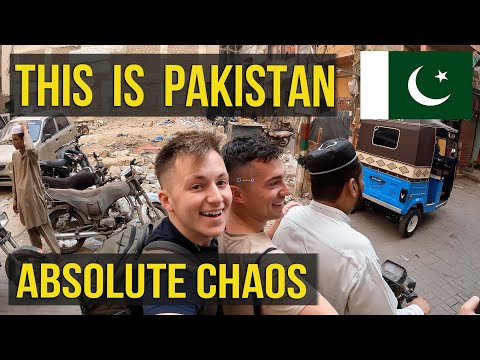
Harry's first full day in Karachi — a rickshaw to wherever the food is, a lift from a politician on a motorbike, a biryani, a rickshaw fare he forgot to agree first, and SIM cards.

Video
$140 ULTIMATE FAKE MARKET SPREE (Karachi, Pakistan) 🇵🇰
Harry works Karachi's Zainab Market for copy shirts, a tailored shalwar kameez and a first-copy watch, then buys a second-hand iPhone because Pakistani SIMs won't run in a foreign handset.

Video
UK tourist travels to KARACHI, PAKISTAN 🇵🇰
The travel day that opens Harry's 40+ video Pakistan series — Amman to Karachi via Sharjah, a visa that nearly cost them the flight, and a 3am arrival.

Video
Foreigner Meets Crazy Pakistani Locals🇵🇰
The national mausoleum at sunset with a flag-lowering ceremony, the strictest bag security Harry has met anywhere, and a cheese paratha he knowingly overpays for.

Video
Westener In Pakistans Biggest Market 🇵🇰
Buying a shalwar kameez and a ring at Zainab Market, losing the negotiation and saying so, and a tuk-tuk ride so smoky Harry hangs his head out of it.

Video
BEST Hotel in PAKISTAN ($200/night)🇵🇰
What $200 a night buys in Lahore — three lanes of armed security at the gate, a spa, and the first properly expensive Pakistani meal of the trip, eaten under edible silver leaf.

Video
Exploring Modern Pakistan 🇵🇰
Port Grand on Harry's birthday — Karachi's modern waterfront strip, a mangrove boat ride, pani puri, and families out with small children at ten at night.

Video
Avoid This Pakistani Man! Karachi Airport Scam 🇵🇰
Flying Islamabad to Karachi for $80 with a meal on a two-hour hop, a 1,000-rupee minimum just to leave the airport, and a porter who carried nothing and would not leave without being paid.
Linked from
- Islamabad Place
- Lahore Place
- Pakistan Country
- Agree the price before it starts Tip
- Be assertive with touts Tip
- Buy the thing, don't give the cash Tip
- Cover up in conservative countries Tip
- Don't point the camera at private moments Tip
- Haggle with a reference price Tip
- Stick a thumb out Tip
- Insist on paying Tip
- Judge a place for yourself Tip
- Kieran Person
- Mac Person
- Walid Person