Place
Nuwara Eliya
Sri Lanka's "Little England" — a cold, cloudy hill town of tea plantations with Edinburgh on a plantation sign, a pub, a Windsor Hotel, and Tamil rather than Sinhala in the streets.
Nuwara Eliya
A town in the hill country of Sri Lanka, south of Kandy, which Harry is told before he gets there looks like England.
Getting there by train
The journey is the reason most people come this way, and is routinely called one of the most beautiful rail rides in the world.
- About four hours from Kandy, scheduled at 8:30 and leaving nearer 8:47.
- Three classes. Third costs about 200 rupees — roughly $1 — with no reserved seats; see take the cheapest class.
- The line climbs through jungle, then open valleys, villages and tea plantations. Potatoes are grown up here too, which Harry doesn’t expect.
- Watch which station you get off at. He and Mac miss theirs and get off at the next one, a small village halt in the terraces, and finish the trip by tuk-tuk. Tuk-tuks are found for you at these stations without asking.
Little England
The town’s nickname, and per the video description it is colonial in origin: this is the coolest place in the country, so the British made it their hill retreat in Ceylon — a place for fox, deer and elephant hunting, polo, golf and cricket — and the naming stuck.
What survives of it, in the street:
- A tea plantation with “Edinburgh” signed across it.
- Devon Cottage, a Windsor Hotel, a pub, and the Bank of Ceylon.
- The Lion Centennial clock tower, officially opened in 2007 per its plaque.
- Architecture Harry calls a cousin of British rather than a copy. His line is that this is how Sri Lankans think England looks, and it is not quite what England looks like.
The cold, and the cloud
- Around 15–20°C, which after a week in the lowlands he finds genuinely cold — it is the coolest area in the country.
- Heavy cloud that rolls over the hills, which he thinks looks better here than the same weather does at home.
- A local’s account of the seasons: April, May and June are the bad months. Harry got this in February anyway.
Practical
- This is Tamil-speaking country. The Sinhala greetings that worked all week in Kandy don’t land here.
- A tuk-tuk from an outlying station to town runs about 3,500 rupees — $17 or $18 — which is what the missed stop cost.
- Eating in the Western-facing part of town is dearer: two noodle dishes, an egg fried rice and three iced coffees came to 3,850 rupees, just under $20, or about $10 a head. He says outright this is above the Sri Lankan norm.
- Guest houses are the alternative to hotels and give you a kitchen, a washing machine and far more space — see book for the wi-fi when you work on the road.
- Local buses run from a terminal in the centre.
- The market sells jackets, shoes and clothes, plus counterfeit branded caps at around 650 rupees and socks at 300.
The market, in detail
The central market is where the town’s shopping is, and it is almost entirely warm clothing — odd in a hot country until you remember this is the cold one.
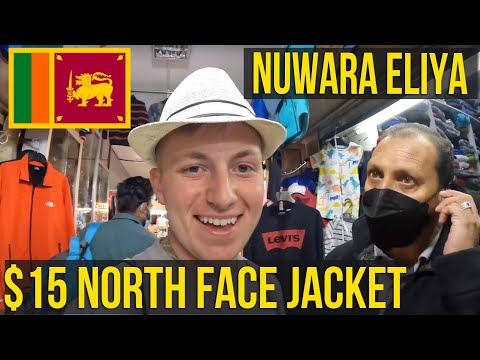
- Jackets run 2,000 to 7,500 rupees, roughly $10 to $37, for what is sold as the same garment at different stalls. Harry pays 2,800, about $14.
- Every stall sells the same stock. He does four laps and says so to the sellers.
- Prices move when a camera appears — one seller triples his quote on realising Harry is filming.
- Counterfeit branded caps at around 650 rupees, and socks at 300.
Why the labels are cut out, per a seller here: Sri Lanka manufactures for Western brands, a run of ten thousand pieces will have two or three thousand rejected at quality control, and those cannot legally be sold locally as branded goods — so the label is removed and they come to markets like this. Real or fake is therefore the wrong question; the honest answer is the same factory, a garment the brand refused — or a straight copy, and no way to tell which. (The seller’s account, uncorroborated.)
The temple
A small Buddhist temple in the town, with a large Buddha above it, smaller painted figures, a tree growing in the middle of the courtyard, incense and offerings. Shoes off at the entrance. It is Harry’s first temple visit in the country — he never got into either of the ones in Kandy — and his approach is to stay out of the way of people who are there to pray.
Harry’s tips
- Check which station is yours before the doors open. Getting it wrong costs the price of several days’ meals.
- Come for a tea plantation with a day in hand. He arrives too late to do one and says it is the regret of the visit.
- Don’t judge the town by the station crowd. A great many tourists get off the train and almost none of them are visible in the town afterwards.
- Do the whole market before you buy anything. It is small, the stock repeats, and the same jacket varies by a factor of three across it.
- Walk away and come back. If the price has held, that was the price.
Leaving, towards Ella
- About four hours by train to Ella, and the most scenic stretch of the whole line.
- $5 in first class, against about $1 in third from Kandy. First class is air-conditioned, reserved, nearly empty — and its windows are sealed.
- The crops change as the line drops south, from tea to other planting and palms.
Source
- Chaos on $1 Sri Lankan Express 🇱🇰 — https://www.youtube.com/watch?v=RToF3gJBTeY
- We didn’t expect an English Town in Sri Lanka! 🇱🇰 Nuwara Eliya — https://www.youtube.com/watch?v=yx6IP7cFyVQ
- $14 North Face Jacket in Nuwara Eliya 🇱🇰 — https://www.youtube.com/watch?v=IsCbHfG6sM8
- Best Train Ride in the World (Only $5)🇱🇰 — https://www.youtube.com/watch?v=T_b8ggPhVvA
Videos featuring Nuwara Eliya
Video
$14 North Face Jacket in Nuwara Eliya 🇱🇰
An hour comparing jackets across one hill-town market, and the seller's explanation of why the labels are cut out — factory overruns and QC rejects that can't legally be sold locally.

Video
Chaos on $1 Sri Lankan Express 🇱🇰
A 200-rupee third-class ticket from Kandy towards Nuwara Eliya — no seats, a scramble for the ones there are, live music in the carriage, a monkey through the window, and a missed stop at the far end.

Video
Best Train Ride in the World (Only $5)🇱🇰
The same hill line in first class this time — $5, air conditioning, reserved seats, a film playing, and windows that don't open, which is the one thing that matters on the most scenic railway he has ridden.

Video
We didn't expect an English Town in Sri Lanka! 🇱🇰 Nuwara Eliya
A $17 tuk-tuk to fix a missed train stop, then an afternoon in Sri Lanka's "Little England" — Edinburgh on a tea plantation, a pub, 15°C and cloud, and his first temple visit of the trip.
Linked from
- Ella Place
- Kandy Place
- Sri Lanka Country
- Ask what a local pays Tip
- Book for the wi-fi when you work on the road Tip
- Take the cheapest class Tip