Country
Israel
Four hours of airport questioning to get in, then a country where beach life and war infrastructure occupy the same streets — and the first place Harry says he has been able to ask anything he likes on camera.
Israel
Harry travels alone through Israel and the Palestinian territories, and states his method at the top: he will speak to Israelis, Palestinians, settlers and religious communities, listen to all of them, and present the range without picking a side. He also says he knows he will be attacked by everybody for it.
The line he opens with is the one he has said in a dozen other countries and says is especially true here: there is a difference between a government and its people.
This page records what people told him, attributed to them as speakers. Where they contradict each other, both are here. Where Harry states a figure, it is recorded as his.
Obs: the video carries a long eSIM sponsor read and a plug for Harry’s group trips, and its description links a set of Palestinian-owned businesses he asks viewers to support. Only the travel and interview content is recorded here.
Getting in
The most practical section on the page, and a cautionary tale.
- He was reported by the passenger next to him on the flight, who saw him deleting Palestinian contacts from his phone in anticipation of the phone being searched. He calls doing it on the plane very stupid of him.
- He was pulled out of the immigration queue before reaching it and spent four to five hours in an office across several interviews.
- The questions were about his life, not his trip: how much he earns, who he works for, why he had been to Lebanon four times, and why he had been to Yemen, Somalia and Afghanistan. His answer was that they could watch his videos.
- They found a clip of him saying he loves Palestine and were unhappy about it.
- His bracelet has his name in Arabic on it, which the officer read immediately.
- He was told plainly that his colleagues did not want to let him in. He was let in anyway, and says he does not know why.
Observations
From I Visited the World’s Most Controversial Country 🇮🇱
- Ordinary life and war infrastructure share the same streets, which he says he has never seen anywhere else. Hostage posters, bunkers built into pavements, people in army uniform and civilians carrying guns — alongside a full beach.
- The Iron Dome is why normal life continues. Harry’s figures: 2,500 rockets intercepted at around a 90% success rate.
- When the sirens go you have about 90 seconds to reach a shelter.
- Israel is extremely expensive, which he names as the single clearest difference from its neighbours.
- Saturday shuts the country down. Buses and trains don’t run on Shabbat, which is how he ends up being driven to Jerusalem by a subscriber.
- Around two million Arab citizens of Israel, roughly 85% Muslim. What he is told about their position: an individual can reach the top of any profession — the example given is a hospital consultant — while Arab villages are visibly less developed as communities.
- Israeli Arabs cross into the West Bank to shop, because prices are far lower. Fruit, vegetables and general goods yes; meat and eggs cannot be brought back.
- Tel Aviv is a refuge for LGBT Palestinians, according to an Israeli Harry speaks to, because of how the subject is treated at home.
- This is the first country Harry says he can speak freely in. He contrasts it directly with Russia, Afghanistan, Yemen and Syria, where he says the government makes open questions impossible, and calls the ability to ask anything on camera genuinely novel for his channel.
The founding date, twice
At Independence Hall in Tel Aviv, Harry gives the fact the rest of the video hangs on:
- In 1948 Ben-Gurion declared the State of Israel in that room, as the British mandate ended.
- Five Arab armies invaded the next morning.
- 750,000 Palestinians were displaced.
- The same day is Independence Day in Israel and the Nakba in Palestine — one date, two realities, which is how he frames the entire trip.
From I Was Warned Not to Cross Into Palestine 🇵🇸
A day in Jerusalem a year later, and what it adds here is the state of the tourism economy and one long conversation.
- Tourism has not come back. One tourist counted in a day in the old city, where before 2023 the streets carried Christian, Jewish and Muslim visitors from everywhere. Shopkeepers say business is very bad.
- Foreign labour has replaced Palestinian labour around Jerusalem — workers from India, Sri Lanka and Ethiopia, according to a friend travelling with Harry, because Palestinians who used to work in Israel in large numbers can no longer cross at all.
- An Israeli who moved from Vancouver and did four years in the army, now studying tourism, carrying a gun, and on his fourth reserve call-up so he cannot start his course. What he says: extremists exist on both sides, most people are fine day to day, he has no problem with Muslims or Palestinians, two states would suit him — and that saying so is controversial. His advice to Harry is to go and see both sides. He also says an Israeli passport is very easy to get if you are Jewish.
- A figure Harry puts to him — that 70% now want one state — gets an answer that it is higher since 7 October than before, without confirming the number (from video – unverified; the figure is Harry’s own).
- Two Israeli men stopped for him on the road into the West Bank, changed his punctured tyre and refused the roughly $30 he offered. It is the single event the video is built around; see talk to both sides.
What people told him
Recorded as positions held by the people who stated them.
An Israeli woman on the right, who grilled him rather than the other way round:
- Nothing that happened on 7 October was acceptable, and defending against it is not comparable to causing it.
- She disputes Harry’s casualty figure for Gaza. He cites around 70,000 from a quick search; she rejects both the number and the source, and says the IDF is right.
- Jewish people have the right to exist and this is their country; she points to the flag and the currency as her evidence.
- One state, not two: she will not hand a state to people she regards as enemies.
- On the West Bank settlements, which Harry puts to her as illegal under international law: she supports whatever her government decides, and says Judea and Samaria belong to the Jewish people on both religious and national grounds.
- Asked whether she may have grown up on one-sided material, she says no — and adds that Israeli opinion was much more left-wing before 7 October, and that nobody is a dreamer now.
An American moving to Israel: he describes the country as one large family, gives the example of a taxi driver who gave him his number and invited him to dinner within ten minutes, and separately says there are violent settler groups who need to be punished and that the police should act against them — while noting attacks in the other direction too, and calling the West Bank lawless and chaotic on both counts.
Younger Israelis in Tel Aviv, who broadly want a two-state solution, say nobody wants innocent people killed, and think about Gaza and the West Bank daily. One offers a solution: disarm Hamas completely and find a governing body not committed to attacking Israel. On settlers, another says the situation is complicated militarily, disagrees with radicals on both sides, and thinks the two populations have to find a way to live together.
An Israeli in his fifties: the effects of 7 October are in every conversation and every news item; optimism is a duty rather than a feeling, because there is no other option, and after 80 years of fighting for existence, peace has to be believed possible.
An Israeli Arab, who drives Harry to Jerusalem: life in Israel is good compared with most countries and could be better for his community. On identity, the sentence Harry keeps: in Israel he is an Arab, and in Arab countries he is an Israeli. Asked whether he thinks about having been born on the other side of the line, he says he thinks about it constantly — that people there have no income, no state to help them and nobody to help them, and that he cannot imagine it.
A settler in the West Bank, from I investigated illegal Israeli settlers in the West Bank 🇵🇸🇮🇱. Harry describes her as a well-known influencer; she is not named here, because the subtitles never render a name. Her positions, at length and in her own framing:
- She came from a very religious family and moved to the settlement after 7 October, and describes living there as one of the ways of serving God. She uses Judea and Samaria throughout, never “West Bank”.
- She says it is very safe and that she has had no problems, and that visitors should come and see it for themselves — the same instruction Harry gets from Palestinians a few hours later.
- The nearest Palestinian village is in sight, with Tel Aviv behind it. She would not go there; her reason is that they don’t like her.
- She does not believe peace will happen, though she says she wants it. Her argument is about children: she believes Palestinian children are raised to kill Israelis, and that until that changes there is nothing to build on.
- She distinguishes Hamas from Palestinians when pushed, and then doesn’t — asked directly whether she thinks every West Bank Palestinian is Hamas she says no, but says she is certain none of them want Israelis there.
- The strategic argument for the settlements, which she gives when Harry puts their illegality to her: these are the mountains in the middle of the country, any army would want them, and without them she expects a second and much larger Gaza within rocket range of Tel Aviv.
- The historical claim: the Torah, and archaeological evidence she puts at two and a half thousand years. Asked what she says to people whose book makes the same claim, her answer is that this is the conflict — and that if it is one or the other, it is hers.
- One state, and a future for Palestinians in Europe. She says she wants them to live and to study, and thinks that future is elsewhere. Harry puts to her that support for two states was higher before 7 October; she is proud that it has fallen.
- Asked to condemn violent settlers, she does — a small group, not her way, not the Jewish way, and she names the harm it does to Israel’s standing abroad as part of the reason.
- On the price of living there: she says every Israeli pays one, that this is why everyone serves at 18, and that she puts her country and her religion above herself.
- What she would say to a Palestinian watching: teach your children peace, and don’t put your money into terror.
Obs: the same video includes an informal farm outpost placed between two Palestinian communities to stop them joining up — illegal under Israeli law as well as international law, as Harry notes on camera. It is recorded here rather than as a place because it is not a settlement with a name.
Obs: the video also includes a news clip reporting that a United Nations investigation team found Israel had committed genocide against Palestinians in Gaza. It is played as part of the opening montage.
Places
Videos featuring Israel
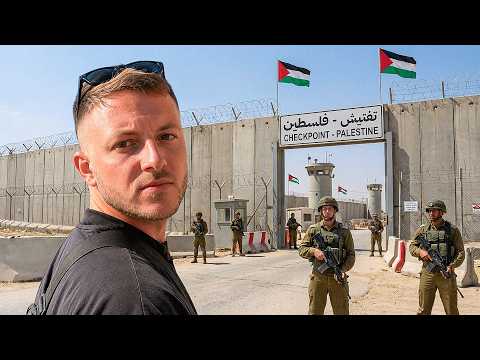
Video
I Was Warned Not to Cross Into Palestine 🇵🇸
A day in the old city of Jerusalem — Western Wall, Al-Aqsa, Holy Sepulchre, the invisible Green Line — and then a rented bike, 10 km south to Bethlehem, through a checkpoint, a wrong detour and a puncture.

Video
I Visited the World's Most Controversial Country 🇮🇱
Five hours of airport questioning, then a week of interviews across the political range in Tel Aviv and a tense afternoon in Jerusalem's old city — Harry's stated method is to listen to everyone and pick nobody.

Video
I investigated illegal Israeli settlers in the West Bank 🇵🇸🇮🇱
A day with an Israeli settler and then a day with a Palestinian driver in Bethlehem — the same land explained twice, plus the clearest account in the bundle of gates, ID colours and permits.
Linked from
- Tel Aviv Place
- Palestine Country
- Talk to both sides Tip