Country
Palestine
Harry's observations from the West Bank — Oslo zones, village gates, green and blue ID cards and the three permits, collapsed tourism and work, and overwhelming hospitality.
Palestine
Harry cycled through the West Bank in 2026 — Bethlehem to Hebron — as part of a series showing everyday Palestinian life beyond the headlines.
Observations
From The Side of Palestine the Media Doesn’t Show You 🇵🇸
- Geography of control: the Oslo Accords carve the West Bank into Area A (Palestinian cities), Area B (shared), and Area C (about 60% of the land, full Israeli control, where Palestinians effectively can’t get building permits). The 1949 Green Line exists on maps but not on the ground. Gates across roads control traffic flow and force long detours — a bicycle slips through where cars can’t.
- Hospitality: the defining experience. Strangers stopped to give Harry water on the highway; kids mobbed him in every village; a subscriber’s family took him in for tea within five minutes of meeting him. He contrasts it directly with five days in Tel Aviv where no stranger approached him.
- Olive trees: the historic economic lifeline and near-sacred to Palestinians — which is why settlers burning them cuts so deep.
- Settler friction: locals warned him about rock-throwing on the Bethlehem–Hebron road; in Hebron he saw the physical evidence — caged market streets, closed shops, families recounting violence (their accounts, as told to him).
- Tourism: collapsed since the war; shopkeepers ask visitors to come, film, and “not forget us” — they value the visibility as much as the money.
- Money and costs: fresh orange juice 5 shekels; handmade keffiyeh 40 shekels; a filling lamb-and-rice lunch at a place that refused to let him order a second dish.
- Safety: Harry cycled alone, mid-war, and his worst problems were hills and an overloaded backpack; checkpoints treated the foreign tourist far more gently than the locals crossing beside him.
From I Visited the World’s Most Controversial Country 🇮🇱
The Israel half of the same trip, and what it adds here is context rather than Palestinian material — the West Bank content is above.
- The founding date, twice. At Independence Hall in Tel Aviv: Ben-Gurion declared the State of Israel in 1948, the British mandate ended, five Arab armies invaded the next morning, and 750,000 Palestinians were displaced. The same date is Independence Day in Israel and the Nakba here.
- Arab citizens of Israel cross into the West Bank to shop, because prices are far lower — fruit, vegetables and general goods, though meat and eggs can’t be brought back.
- What an Israeli Arab says about the line he was born on: that he thinks about it constantly, that people on the other side have no income, no state to help them and nobody to help them, and that he cannot imagine it.
- Harry names the price of admission. Deleting Palestinian contacts from his phone on the flight got him reported by the passenger beside him and cost him five hours of questioning at Tel Aviv airport, where a clip of him saying he loves Palestine was produced as evidence.
- He asks viewers to spend money here, and links Palestinian-owned businesses in the description — guides, a taxi driver and shopkeepers — on the grounds that tourism income is what is missing.
From I Was Warned Not to Cross Into Palestine 🇵🇸
The day before the Bethlehem–Hebron ride above: getting in at all, by bicycle from Jerusalem.
- Crossing is the difficulty, and it is administrative rather than dangerous. Checkpoint staff sent him on a driving detour adding 6 km; a taxi driver knew a pedestrian route; the pedestrian route wouldn’t take a bicycle, so the detour happened anyway. A different road in had no checkpoint and no security at all.
- The wall is 8 m, on his figure, and he first meets it circling Bethlehem with no obvious entrance.
- Road signs mark villages Israeli citizens are prohibited from entering — the restriction running in the other direction, which he notes without comment.
- It doesn’t read as a border, it reads as a different region. Lebanon, Syria, Egypt; and considerably more developed than he had been told to expect, closer to Beirut.
- The warnings were symmetrical and both wrong. Israelis told him Palestinians would blow him up; Palestinians told him Israelis would shoot him. What actually happened is that two Israeli men stopped for a stranded cyclist heading into the West Bank, drove him somewhere quiet, changed his tyre and refused the roughly $30 he offered — we do good deeds around here. See talk to both sides.
- Tourism: a four-star family-run hotel in Bethlehem at $50 a night that has had zero tourists in two years. His closing argument is that the losses nobody reports are the businesses with no income and the jobs gone, belonging to people with no connection to any of it beyond where they live.
From I investigated illegal Israeli settlers in the West Bank 🇵🇸🇮🇱
The last video of the series, and by some distance the most useful page-material in it: a day with an Israeli settler followed by a day with a Palestinian driver in Bethlehem, who explains the administrative machinery the earlier videos only glimpse. The settler’s positions are recorded on the Israel page with the other Israeli voices.
The figures Harry opens with, attributed by him to the UN and recorded as his:
- Around 1,800 settler attacks on Palestinians in the West Bank last year — the highest since counting began 20 years ago, roughly five a day.
- Over 230 Palestinians killed in the West Bank by Israeli forces and settlers in the same year, against 12 Israelis killed in Palestinian attacks on settlers.
- 54 settlements approved in a single year, where the previous record was nine; 86 new outposts, illegal under Israeli law as well as international law; and nearly 28,000 new homes through planning.
- The Oslo split was meant to last five years, and is about thirty years old.
The wall, and the video disagrees with itself about it:
- Harry gives roughly 700 km and about 8 m — twice the height of the Berlin wall. The Palestinian driver gives about 780 km, and 8 m with another 2 m on top (from video – unverified; both figures are stated in the same video and not reconciled).
- Both agree on the shape: it does not follow the 1967 line, it wanders like a snake deep into the West Bank, and it separates farmers from their fields and villages from their water.
- The ICJ ruled in 2004 that the sections built inside the West Bank are illegal under international law.
- It was begun in 2002, under Ariel Sharon.
- Crossing it is now lethal. A watchtower every several hundred metres, permanently manned. Before 7 October, being caught meant a beating or a few days in jail; the driver’s account of the present is a man of 47, out of work since the crossings closed, shot in the face attempting it to reach a job — and his own summary of the odds: 99% you die, 1% you get over.
The gates, which are the part of the system Harry says he did not know about:
- Not a single checkpoint but a gate for every village and town — the driver gives a figure in the high 1,900s (from video – unverified; the transcript garbles the number).
- Since 7 October they are shut, opening mainly when the army goes in. A one-minute drive between a village and Bethlehem becomes four or five kilometres.
Green card and blue card — the single most useful explanation in the Palestine cluster. A green ID means you live in the Palestinian areas; a blue ID means you live on the Israeli side. With a green ID:
- You may not drive into Israel. Palestinian cars carry white plates and stay on the Palestinian side; Israeli yellow plates go both ways.
- You may not buy, build or rent on the Israeli side.
- Marriage across the line is close to impractical: a blue-ID spouse would have to give up their ID to move here, and a green ID cannot be exchanged for a blue one. In practice green marries green — which the driver says has divided a great many families.
- You may not fly from Ben Gurion. Travelling anywhere means Jericho, then Amman, then onward — and a brother who has since taken German citizenship still cannot come in through Tel Aviv.
The three permits, in his account:
- Prayer — to reach Al-Aqsa in Jerusalem, and mostly issued to the elderly.
- Hospital — granted fairly readily for serious cases a Palestinian hospital cannot handle, and useless without money: treatment costing about 100 shekels here can be 10,000 across the line, which he puts at three or four months’ salary (from video – unverified).
- Work — and 99% of it is construction. He is blunt about what that means: building houses on the other side of a dispute about land.
The work economy has collapsed. Around 400,000 Palestinians crossed daily to work in Israel before 7 October; he says roughly 300,000 of them now have nothing, that the labour has been replaced with workers brought from China, India and Sri Lanka, and that the Palestinian Authority does not support them.
What the people inside it say about each other, which is the reason the video is paired with the settler half:
- The driver’s own verdict on the settlement beside his village is that it is peaceful — and that other settlements, further north, are not. His formulation is that his own fingers are not the same as each other, and neither are Muslims, Christians or Jews.
- His estimate of the split on both sides: about 70% on each who would share the country, 30% on each carrying hatred — and that the 30% are the people who lost someone (from video – unverified; his own estimate, offered as one).
- See a government and its people.
Informers are how he explains the jail population, and he says they are now protected by both sides. His figure for people held over social-media posts alone is more than 5,000 (from video – unverified).
Harry’s closing observation, and the one he says he took from the whole trip: he arrived expecting anger and a wish for revenge, and did not find it — people talked about their homes, their children, their olive trees, and whether they would be allowed to build.
Videos featuring Palestine

Video
The Side of Palestine the Media Doesn't Show You 🇵🇸
Harry cycles from Bethlehem to Hebron and walks the world's most divided city — checkpoints, the split Ibrahimi Mosque, Shuhada Street's ghost town, and residents who refuse to leave.
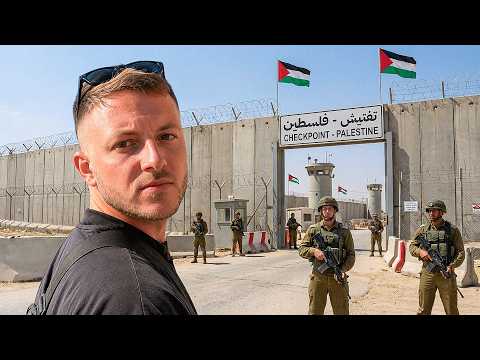
Video
I Was Warned Not to Cross Into Palestine 🇵🇸
A day in the old city of Jerusalem — Western Wall, Al-Aqsa, Holy Sepulchre, the invisible Green Line — and then a rented bike, 10 km south to Bethlehem, through a checkpoint, a wrong detour and a puncture.

Video
I Visited the World's Most Controversial Country 🇮🇱
Five hours of airport questioning, then a week of interviews across the political range in Tel Aviv and a tense afternoon in Jerusalem's old city — Harry's stated method is to listen to everyone and pick nobody.

Video
I investigated illegal Israeli settlers in the West Bank 🇵🇸🇮🇱
A day with an Israeli settler and then a day with a Palestinian driver in Bethlehem — the same land explained twice, plus the clearest account in the bundle of gates, ID colours and permits.