Place
Jerusalem
The old city across two visits — the Western Wall, Al-Aqsa and the Holy Sepulchre within a few hundred metres of each other, an invisible Green Line, no tourists at all, and one day that turned violent.
Jerusalem
The old city, which Harry calls without hesitation the most holy city in the world. No skyscrapers, rustic stone buildings, and — on the day he arrives — very quiet.
He gets there by accident: it is Shabbat, no buses or trains are running out of Tel Aviv, and a subscriber offers to drive him.
Obs: Harry describes this trip as covering Israel and the Palestinian territories. This page records the days in the old city; the West Bank material is on the Palestine page.
Obs: two videos feed this page. The tense day is from the first; the holy sites, the Green Line and the collapsed tourism are from the second, a year later. The sections say which.
The holy sites
Three religions, three of the most sacred places any of them has, inside a few kilometres of each other — which is Harry’s own explanation for everything else on this page. Street signs are in Arabic, English and Hebrew.
- The Western Wall. The holiest site in Judaism, split into male and female sections, and the surviving remnant of the second temple, destroyed by the Romans over 2,000 years ago. Harry stops at the edge and says he doesn’t feel the need to go further.
- Al-Aqsa, the third holiest site in Islam after Mecca and Medina, on the ground where the first and second Jewish temples stood. Muslims once prayed towards it, before the direction changed to Mecca; Muslims hold that Muhammad ascended to heaven here.
- The Church of the Holy Sepulchre, where Christians hold that Jesus was crucified, buried and resurrected. Six denominations share it and argue over control, so the keys are held by a Muslim family as a neutral party — the detail Harry keeps, because it means the religions can’t agree even internally.
Getting into Al-Aqsa as a non-Muslim is deliberately awkward:
- The Muslim entrance turns you away. You go in through the Western Wall side instead — out, straight back in, and up a wooden walkway above the wall.
- Airport-style security to enter a religious site, which he says is a first for him anywhere, the pyramids included.
- A window of 7 to 11 for non-Muslims. He is told that some who come in it want the mosque replaced by a third temple, and on the day he visits a group is there making that point, trailed by police. He is advised to keep clear of them and does.
- It is completely empty. He calls it beautiful, says it’s sad that nobody is there, and that he feels lucky to stand somewhere many Muslims never will.
The Green Line
An invisible line, and the thing he finds most disorienting in the city — he can only locate it on a map, and nobody he asks in the street can point to it.
- It divided East and West Jerusalem from 1948: west under Israeli control, east under Jordanian, until Israel took East Jerusalem, the West Bank and Gaza in 1967.
- Every famous religious site is on the east side. The consequence he draws: before 1967 Jews could not visit the Western Wall; since, Palestinians struggle to reach Al-Aqsa.
- His reaction is not analytical and he says so — religion was meant to bring people together, and this is the opposite. I’m not angry, I’m just disappointed.
He also states his method on camera: two books read before arriving, an effort to be factual, and an apology in advance for anything he gets wrong.
No tourists
Recorded a year after the tense day above, and the more permanent condition of the two.
- He counts one tourist in a day in the old city. Before 2023 the streets were full of Christian, Jewish and Muslim visitors from everywhere.
- A shopkeeper who recognises him from the Lebanon and Iraq videos says business is very bad, then gives him dates, halva and tahini and won’t take money for them.
- The same shopkeeper’s languages, all learned across the counter — Sinhala, Tagalog, Hindi, Polish, Italian, Romanian — and his ranking of tourists by what they spend: Americans first, the French good, the English reluctant. Harry concedes the last one.
- A stall giving cold drinks away on a donations box.
- A Filipino caregiver, twelve years in the city.
- Who is working, and who isn’t. A friend travelling with Harry gives the account: before the attack, large numbers of Palestinians worked in Israel; now they cannot cross at all, and the labour around Jerusalem is done by workers from India, Sri Lanka and Ethiopia.
Prices: flatbread with za’atar at 10 shekels, which he rates 9/10 while still putting Lebanon and Syria ahead of it.
The day it turned
He is explicit that this was not a normal day and that people who live there told him so.
- Arab-owned shops in the old city had closed for that day and the one before, because owners expected trouble. Harry points out the cost of that: the business simply doesn’t happen. One shopkeeper stayed open and didn’t care.
- The IDF were physically preventing a group from entering Al-Aqsa. The explanation he is given on the spot is that the group believe a third temple should be built there.
- A smoke device was thrown into a Muslim-owned shop by, in the account Harry is given by people at the scene, a young Jewish man. A woman was hit. The shop was wrecked. Police and army responded quickly and seriously.
- A large group of young Jewish men then walked towards where it had happened, and Harry’s read is crowd behaviour and showing off: in a big enough group, people think they can get away with anything. The children present were treating it as entertainment.
- A five-year-old shouted an insult into an Arab shop he was buying sweets in — Harry’s own framing is that the child is five and that it is what it is, and that this is one hour of one day.
His decision at that point is to leave: he says he isn’t trying to be part of the problem.
A shopkeeper who has been there seven days, and a friend Harry last ran into in North Korea, both tell him they have never seen anything like it — one of them saying he had been there the day before and it was entirely normal, and that he arrived happy and is now sad.
The market, that day
- Black cherry sweets, extremely sour, which he’d last had in Syria.
- Filipino workers in the old city, which surprises him and which he takes as further evidence that Filipinos are everywhere.
- The driver refuses to let him pay for anything, which Harry names as standard: Arabs, in his experience, won’t take his money.
Harry’s tips
- Don’t travel from Tel Aviv on a Saturday unless you have a lift.
- Read the shutters. Closed Arab-owned shops two days running is the most reliable indicator of how the day is going.
- Leave when it starts. His own instinct and his own words — don’t become part of the problem.
- Go in the 7-to-11 window for Al-Aqsa, and expect to enter from the Western Wall side rather than the entrance that looks right.
- Buy something. The shops here have had two years with no visitors, and the shopkeepers ask for the visibility as much as the money.
Source
Videos featuring Jerusalem
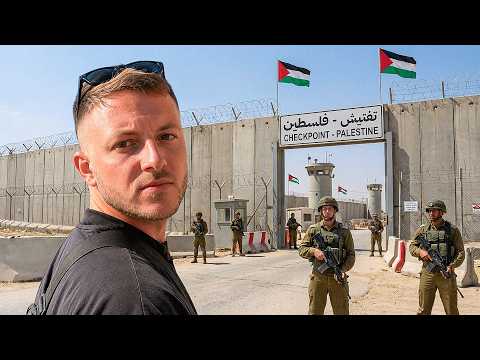
Video
I Was Warned Not to Cross Into Palestine 🇵🇸
A day in the old city of Jerusalem — Western Wall, Al-Aqsa, Holy Sepulchre, the invisible Green Line — and then a rented bike, 10 km south to Bethlehem, through a checkpoint, a wrong detour and a puncture.

Video
I Visited the World's Most Controversial Country 🇮🇱
Five hours of airport questioning, then a week of interviews across the political range in Tel Aviv and a tense afternoon in Jerusalem's old city — Harry's stated method is to listen to everyone and pick nobody.
Linked from
- Bethlehem Place
- Israel Country
- Palestine Country
- Ask someone who drives for a living Tip
- Talk to both sides Tip